4:36
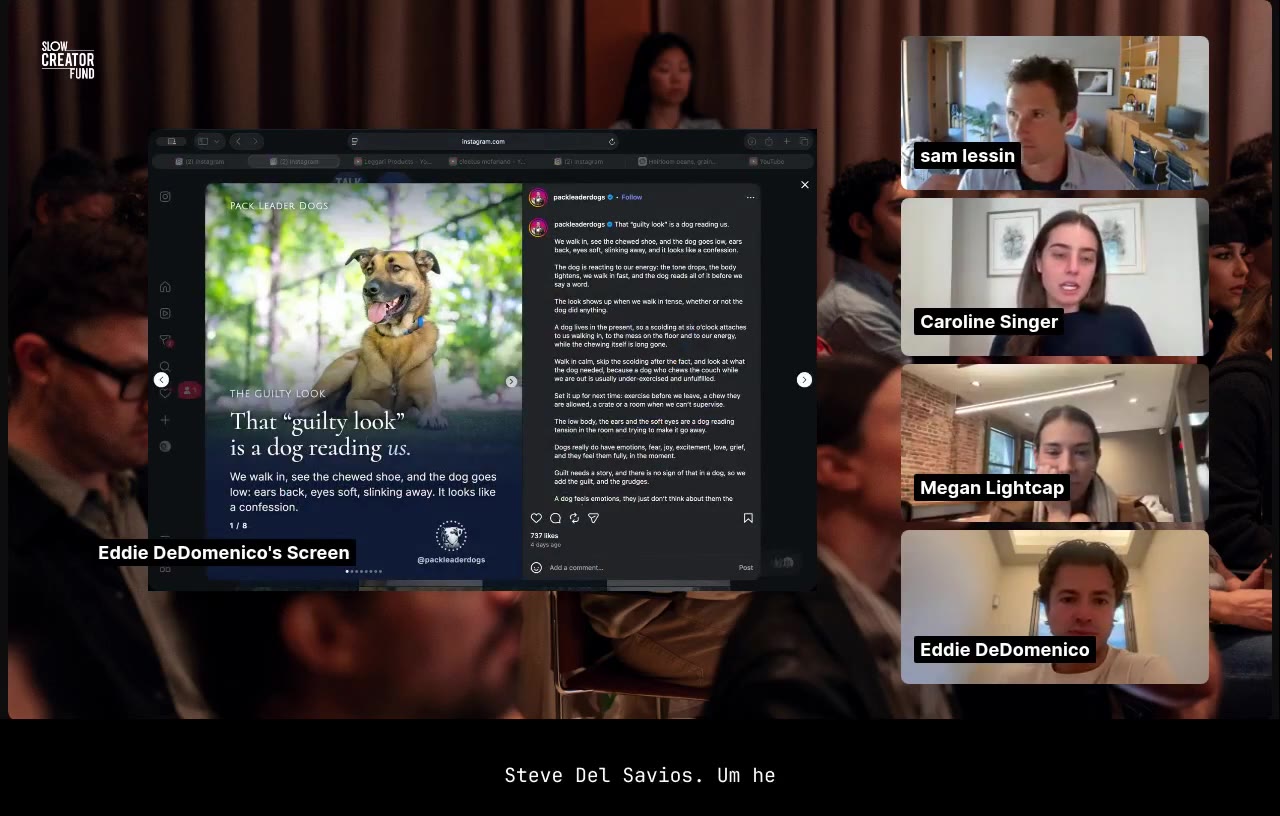
Caroline's pick, framed around her week's theme of 'people who've built three businesses under one platform.' Del Savio approaches dog training from a psychology angle (why dogs are anxious/aggressive, not just obedience) across ~2M followers. Three business lines: Pack Leader Dogs itself (his Jersey facility -- training, private sessions, virtual consultations, booked out ~6 months); Prestige Pet Partners, a partnership with Cesar Milan (who originally trained him) that is actively acquiring and rolling up independent dog-care businesses (grooming, training, daycare -- not breeders); and Understanding the Dog, a paid online community with weekly Q&A and personalized behavioral guidance. Eddie had separately used an overnight dog-psychology trainer and vouched for how legitimate and impressive the work looks in person.
4:27
Eddie's pick (he and Caroline had floated it before; now has a warm intro). Sando started growing heirloom beans himself and selling at a farmer's market ~25 years ago before founding Rancho Gordo. Riding a real category tailwind -- Americans are eating noticeably more dry beans, up about 30% in a year -- he's now selling roughly 2.5 million pounds of beans annually, 5x his 2018 volume. The business has a 30,000-person paying bean club, plus a 30,000-person waitlist he keeps closed on purpose, creating real scarcity on top of real demand. Content (YouTube) is the most underdeveloped channel; everything else -- the brand, the retail/DTC business, press -- is strong and sales are still accelerating. He's 65; Eddie wants to talk succession as well as the business itself.
4:11
Caroline's pick: an interior designer (Jenny Komenda, Little Green Notebook / @jennykomenda) with three business lines. Juniper Print Shop is her direct-to-consumer art brand -- downloadable and custom-framed prints sourced from ~40 independent artists plus vintage and museum-collection finds. Juniper Home is her original interior-design media business (renovations, DIY). The Rooted Home is a newer, faith-based line -- decor and wall art built around Christian themes, run with her husband. Caroline flagged this as a real personal pain point: she's struggled to find well-curated, reasonably priced framed art, trusts neither Etsy (downloads only) nor Wayfair (low quality), and Juniper fills that gap. Megan noted crossover appeal pulling people out of the LDS community into a more mainstream audience as an interesting signal.
3:17
Eddie's pick: Garrett Mitchell, who built his YouTube audience (as 'Cleetus McFarland') over ~20+ years racing and wrecking his own cars on camera, following his father's background in resto-mods. Growth has kept accelerating -- 1.3M views on a video posted the day before the call. In 2023 he bought and renamed a Florida racetrack 'Freedom Factory,' where he now owns and runs real racing events and IP (including hosting an international race brought over from Australia) for real prize money. On top of that he's built Freedom Plus, a paid live-stream broadcast of the races (over 100,000 subscribers at $19.99/month or $120/year, roughly 25 events last year, seven figures of revenue), plus a ~30-person operation and a growing DTC car-products business. Eddie has an inside connection via Mitchell's manager but suspects the manager underrates how big the underlying business already is.
5:18
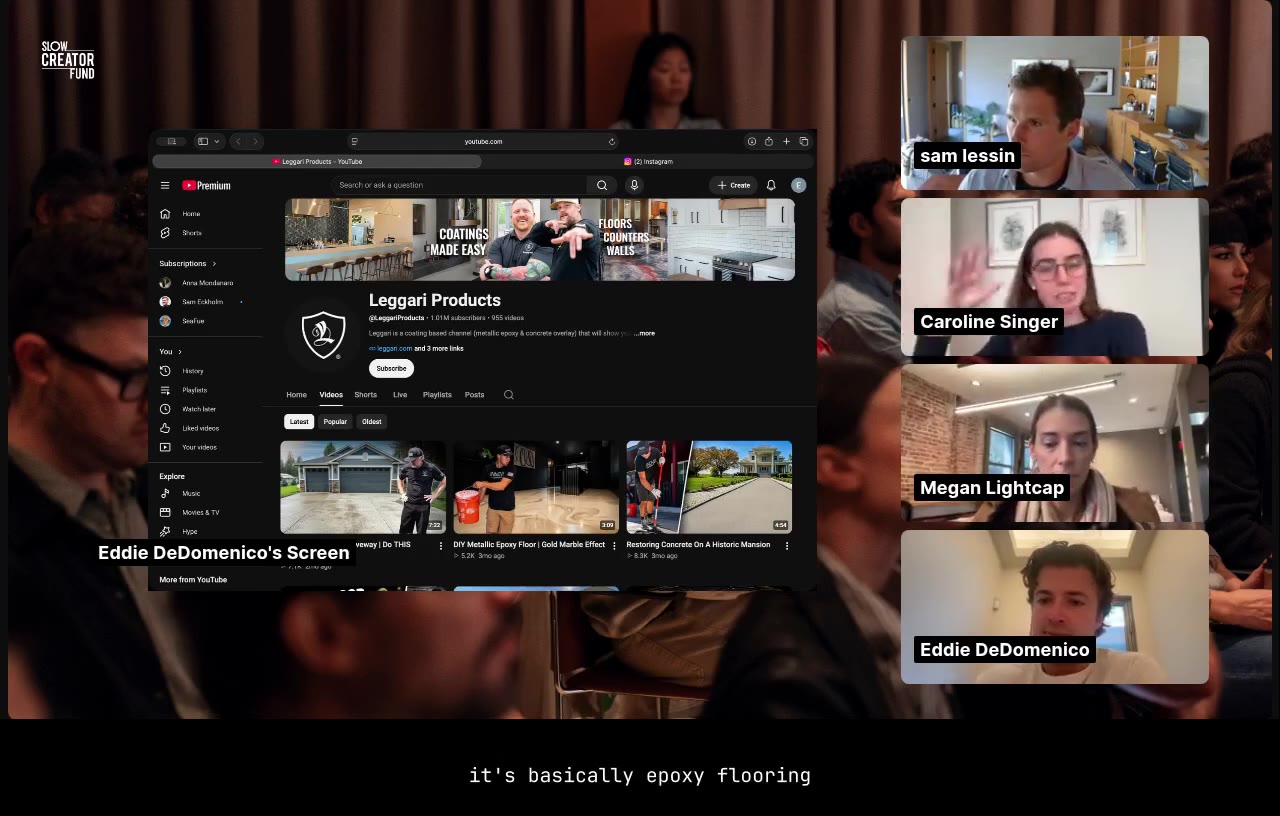
Caroline's pick (transcript misheard the company name as 'Legory' -- it's Leggari, co-founded by Tim Krumland and Tylor Svangren after a countertop-coating video they posted went viral). Three business lines: direct-to-consumer epoxy/concrete-overlay kits for floors, countertops, and walls; Leggari Academy, a paid training and certification program for contractors that has graduated over 15,000 people since launch; and a looser 'pro' mentorship tier for people further along. Eddie connected it to an earlier pitch about Blacktail Studio's proprietary wood finisher -- a pattern of chemical/finish specialists building real IP at a high level. Sam gave a live first-person data point: he wanted to epoxy his garage floor at his Jackson Hole home and didn't, because it was surprisingly expensive -- direct validation of real consumer demand and price friction in exactly this category.
7:56
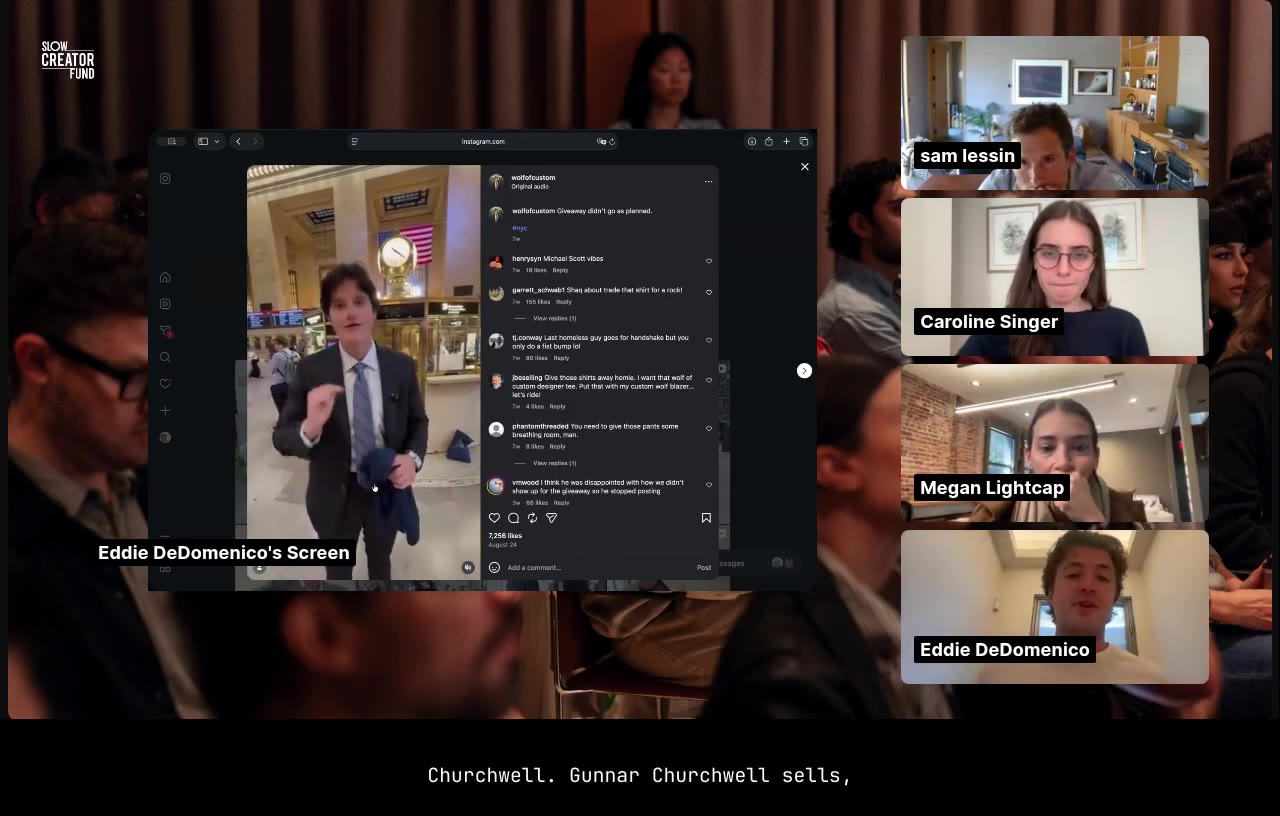
Eddie's closing pick, which turned into the call's longest open debate. Churchwell sells custom suits out of Tom James's New York shop (a ~60-year-old clothier, not a storefront retailer) by walking up to strangers on the street with a camera -- no fear, and apparently very effective: he's won an internal award for the business he's driven, and a friend of Eddie's has tried to hire him away four times. He's built a real following (138,000 Instagram, Eddie estimates ~75% New York-based) among young finance guys who don't know how to dress. The group debated whether formal suit-buying is structurally compressing post-COVID (per Megan and Caroline, most finance guys now own exactly one suit for the one in-person meeting a year) or whether that just means the opportunity is narrower but still real, especially against existing 'easy'/convenience players (Mizzen+Main, State and Liberty, Collars & Co.) that already own the no-effort end of the market. Sam's own anecdote -- he personally owns many suits, including two tuxedos -- was offered as a data point that the high end of the category is alive, just concentrated.
4:20
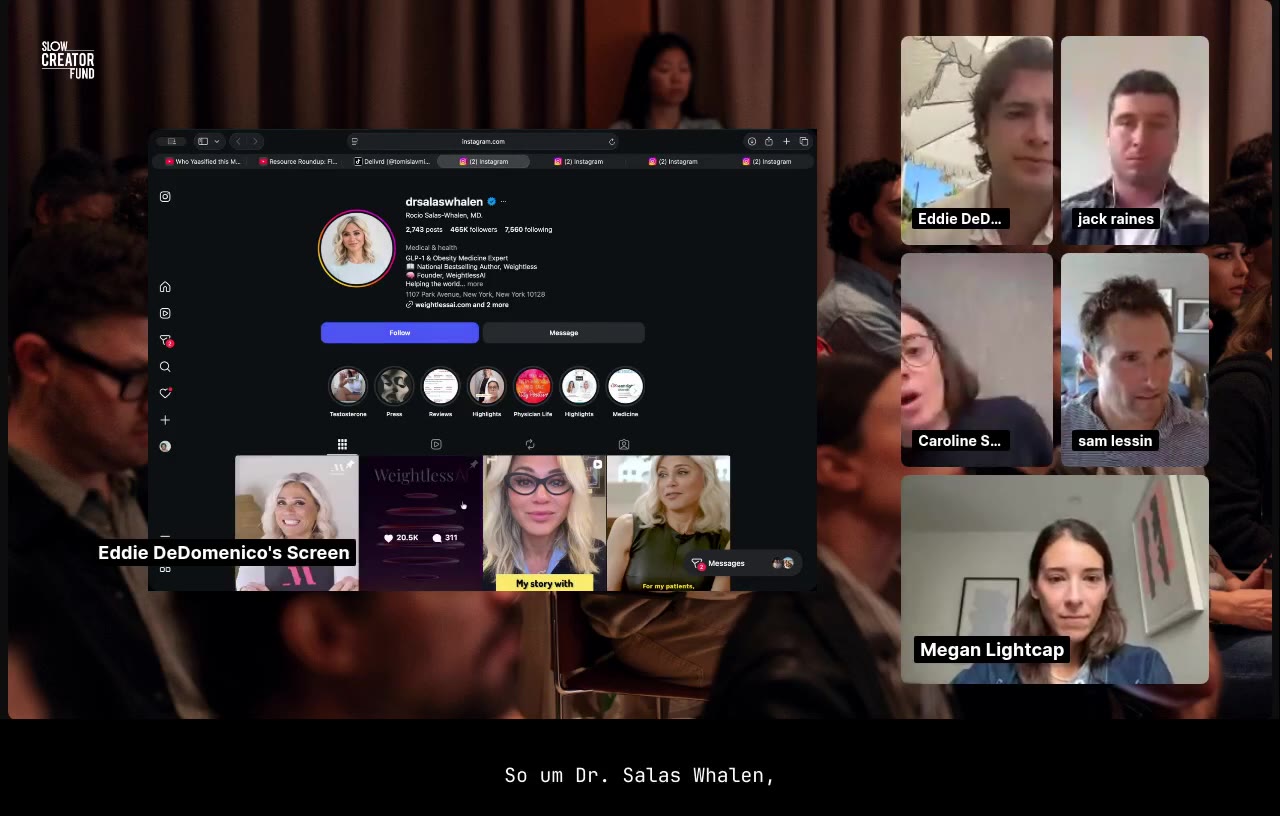
Caroline's pick. Dr. Salas-Whalen is a triple board-certified endocrinologist and obesity-medicine specialist with 16+ years in the field, focused on GLP-1 and metabolic health specifically in women. Recently appeared on Mary Claire Haver's podcast and drew 150+ comments from women discussing their weight-loss journeys and side effects. She already has multiple business lines running together: the Weightless AI app (GLP-1 tracking/guidance for patients and clinicians, with smartphone-based 3D body-composition scans), a national-bestseller book ("Weightless"), StrengthMD (her own protein/fiber supplement brand built for people on GLP-1s), and she still runs her NYC practice. Sam pushed on whether there's a real sub-audience here given how huge and generic "GLP-1s" is as a theme; Caroline's read is that the sharpest angle is women navigating GLP-1 use around fertility and pregnancy (going on/off the drugs, managing weight through pregnancy) rather than GLP-1s broadly. Sam's standing worry about the category: is she helping people manage something or chase it. Action: Caroline will spend more time with her content to pin down whether she's broad or genuinely focused on the fertility/pregnancy angle.
9:50
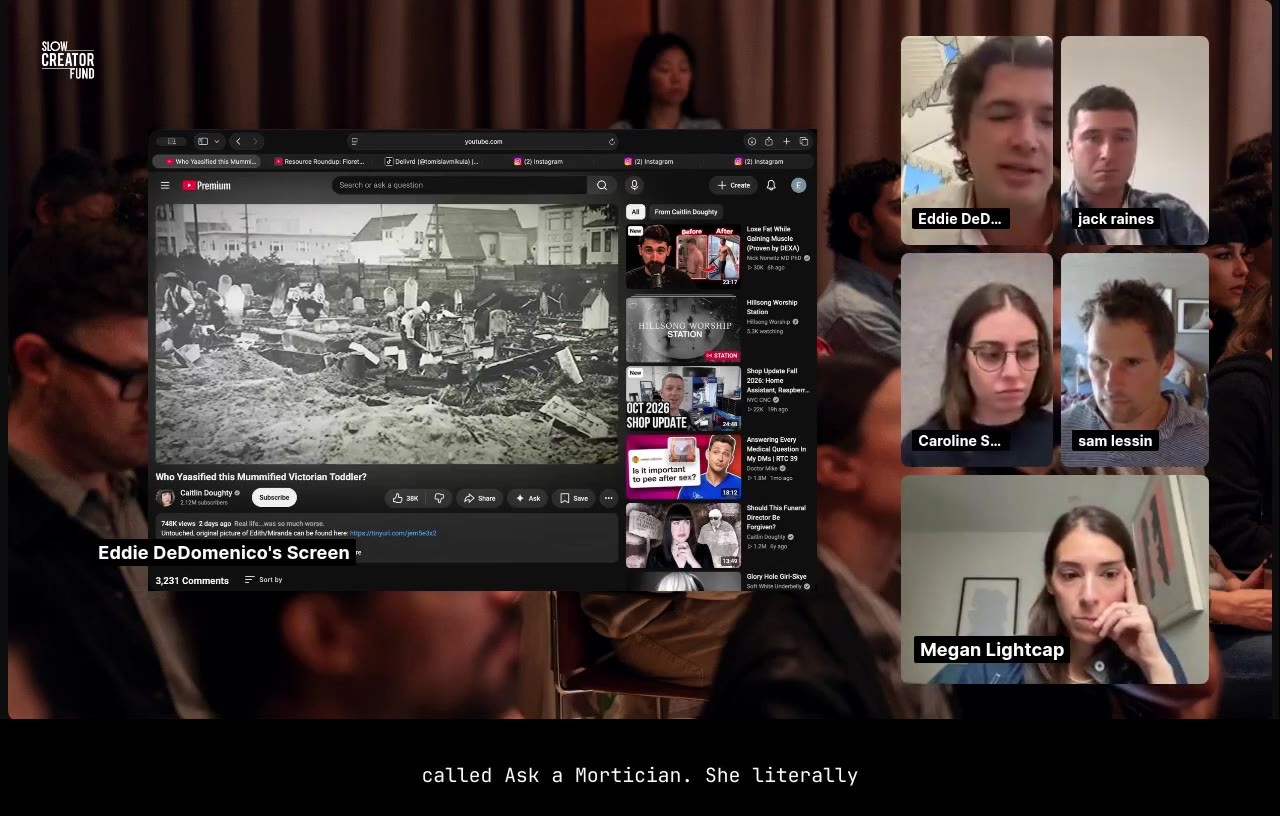
Eddie's pick: he's been circling "death as a category" and landed on Caitlin Doughty, who studied the history of death at the University of Chicago and runs Ask a Mortician. The backdrop: nearly 2 in 3 Americans are now cremated and families spend $32B/year on funerals, a huge TAM with providers nobody trusts. She built the Order of the Good Death (nonprofit, the "death positive movement"), owns two cremation facilities (Clarity, in Santa Ana and LA, despite being based in New York), and has two NYT-bestselling books with a third coming in October. Megan immediately pushed on audience definition: death is enormously broad, spanning afterlife/gothic obsessives, true-crime/grave-tourism types, and people in acute grief needing estate/funeral logistics help — who is she actually speaking to? Sam's harder pushback: he has a structural issue backing creators in the category of "things you don't want to think about" versus things people get excited about — he distinguished a hypothetical "new gothic movement" audience (people who'd be thrilled by a new video/product, which he'd back) from reactive death-planning content (which he's skeptical of, same critique he gave Caroline's GLP-1 pick). Megan's read based on the video title alone: this leans toward the former — fascination with death/history, closer to a modern 'Wednesday Addams' audience — not applied cremation-planning expertise. Caroline will trade notes (she's already met with death doulas/grief professionals) and separately flagged a logistics question (shipping bodies across state lines) that the group tabled for more research.
7:13
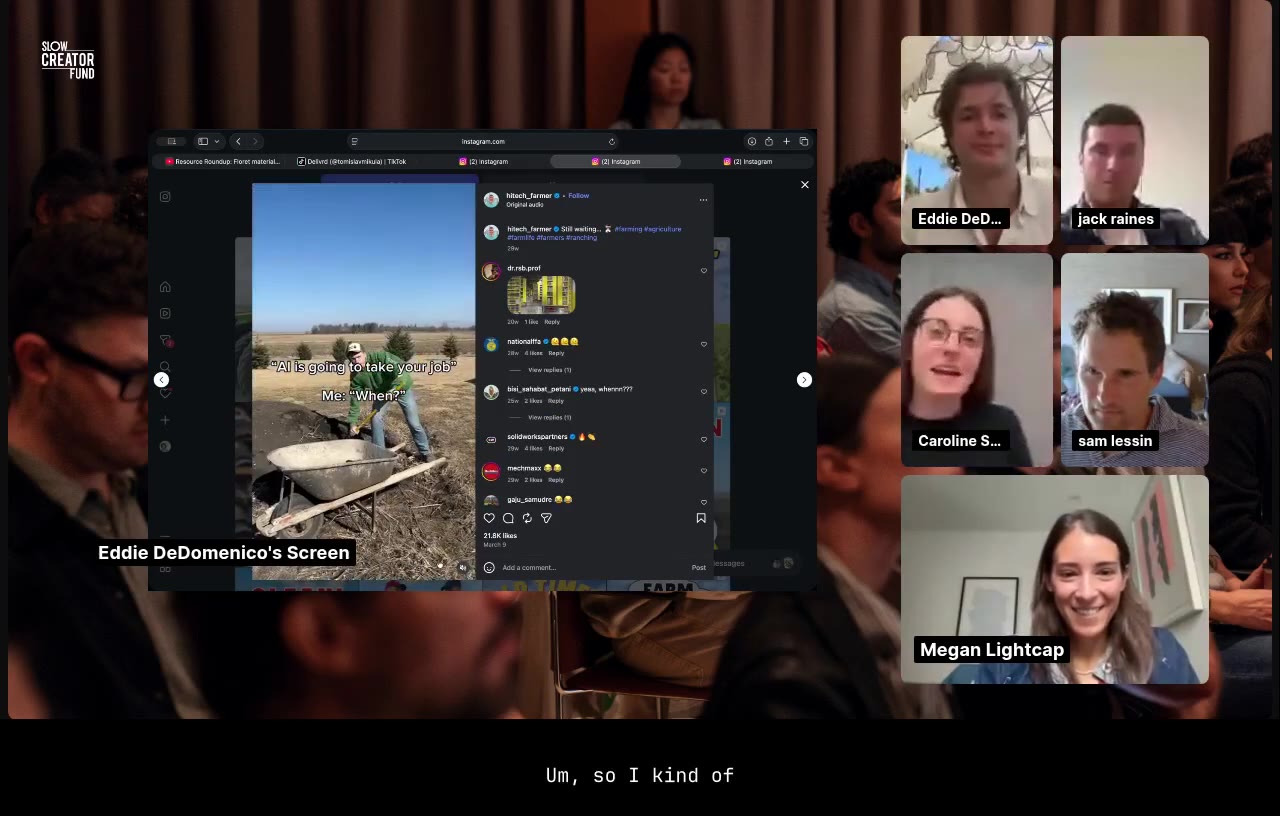
Caroline's pick. Matthias is a fifth-generation Minnesota farmer who returned to the family farm and started documenting the tech he and his family use — drones, GPS-guided machinery, and a drone spraying operation covering a large number of acres with chemicals/pesticides. Strong engagement relative to audience size. Megan framed the useful contrast with the earlier death/GLP-1 picks: this is someone choosing to be excited about using technology, not managing a problem. Caroline's read is the content serves two overlapping audiences — older farmers (incl. his own father/grandfather) wanting to keep working the farm without physically doing everything themselves or hiring large staffs, and a younger generation inheriting farms who want to modernize. He's appeared on Farm4Profit, the biggest podcast in the farming/ag space (few hundred thousand weekly listeners), and had one of their strongest-performing episodes — Megan floated backing that podcast directly, and Caroline has already reached out to them. Jack tried to recall a two-brother farming-media company the team previously diligenced and passed on ("NUS Farms") as a reference point; Megan's memory was that the pass was because they couldn't tell if the two brothers were actually the credible, followed voices in their space. Sam's broader thesis: there's a real opportunity in a new generation of tech-forward young farmers with genuine audience devotion, but the hard part is proving a given pick is actually "the guys," not just "some guys" — there are a lot of farmers on the internet.
1:47
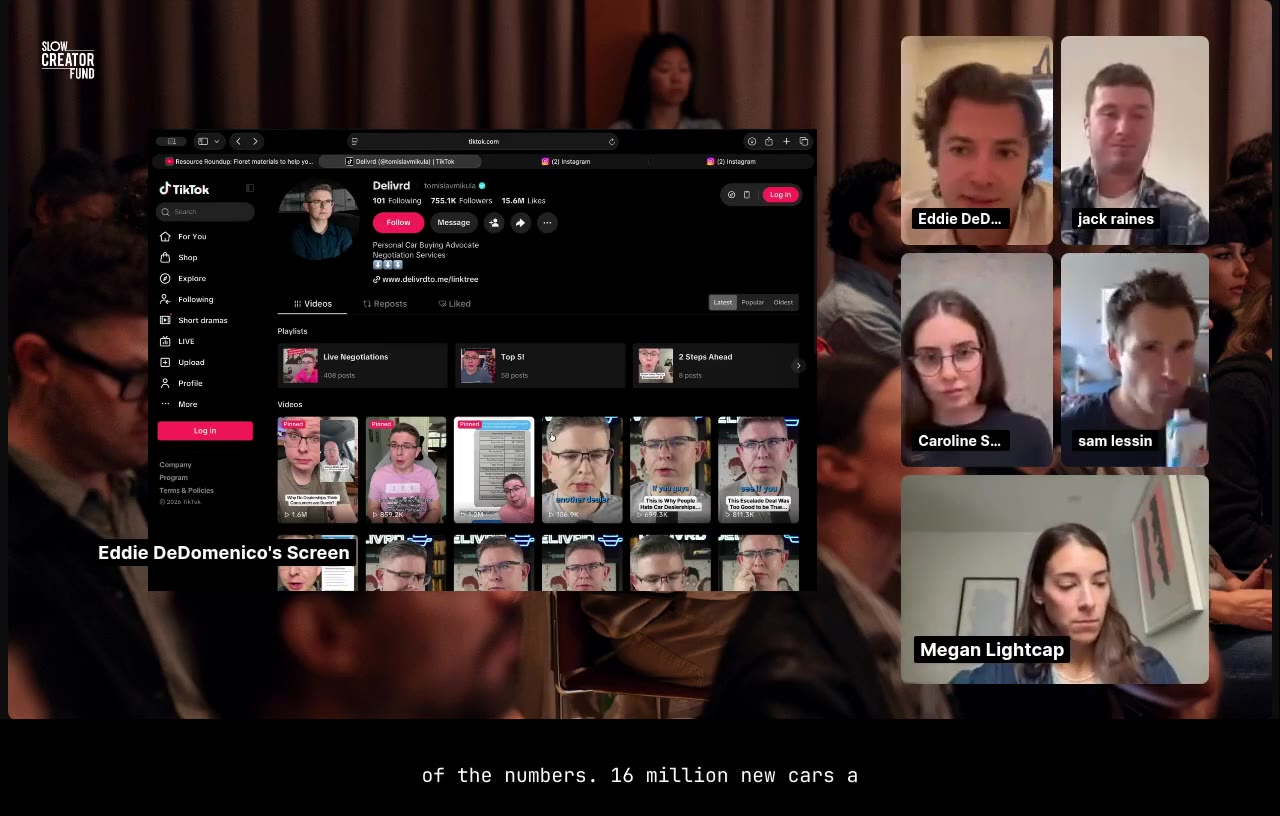
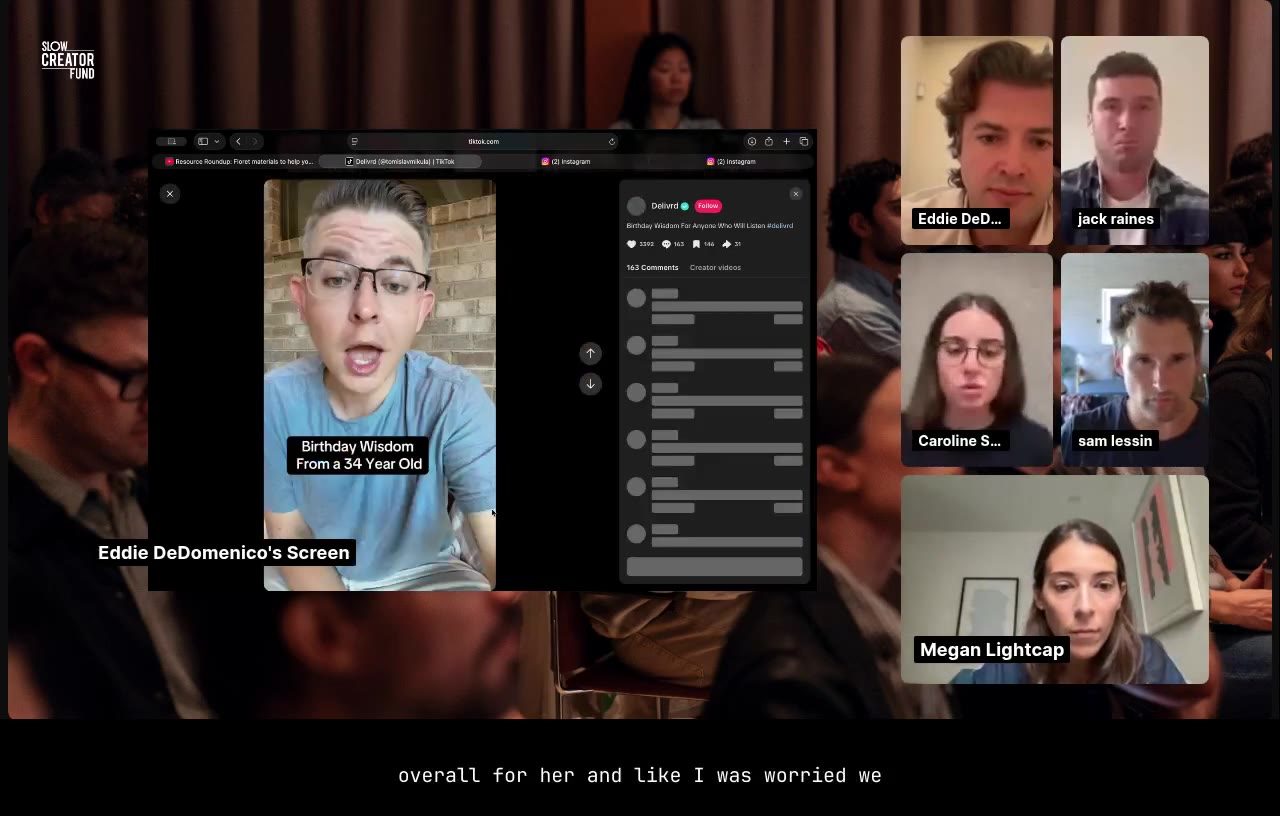
Eddie's pick (transcript-misheard on the call as "Tommy McCoola" — real name Tomi Mikula). Tomi spent years inside car-dealership finance departments, got fed up with how much people hate negotiating with dealers, and built a business live-streaming himself negotiating real car deals with dealerships on behalf of clients, then syndicating the clips to TikTok, where they take off. He charges roughly $1,000 per consultation, did about $2.3M in revenue last year, and is pacing toward ~$4M this year, with 15 remote staff supporting the consulting business. He's started getting picked up by outlets like CNBC — the kind of organic mainstream-media discovery the group has found valuable with other picks before. Eddie is reaching out; he sees Tomi as personally skilled (a genuinely excellent, well-informed negotiator) and the format as scalable because the content and the service are the same motion (watch him negotiate live, then hire him to do yours). Later in the conversation Eddie also noted the business is growing organically — roughly 200,000 new followers across platforms in just the last couple of months.
1:56
Caroline's pick, discussed right alongside Tomi Mikula as a second car-industry creator. Kelly ("the Car Mom") built her entire platform around helping mothers navigate car buying — in-person events, brand partnerships, and consulting, aimed squarely at moms rather than general car buyers. Caroline actually met with her business manager rather than Kelly directly, and came away with a real concern: it's not obvious how this scales past a plateau. Like Tomi, she eventually layered in 1:1 consulting with similar traction, but the business is heavily dependent on Kelly herself — people specifically want her (Caroline is '99% sure her name is Kelly'), so her team can't easily train others to be 'the car expert' in her place. Outside of Kelly literally becoming her own dealership or some other large structural move, Caroline came away unsure what the next stage of the business actually is. Eddie's framing: she's essentially 'an agent at scale,' i.e., the same key-man-risk profile as a high-end individual agent/broker business rather than a true scalable platform.
3:52
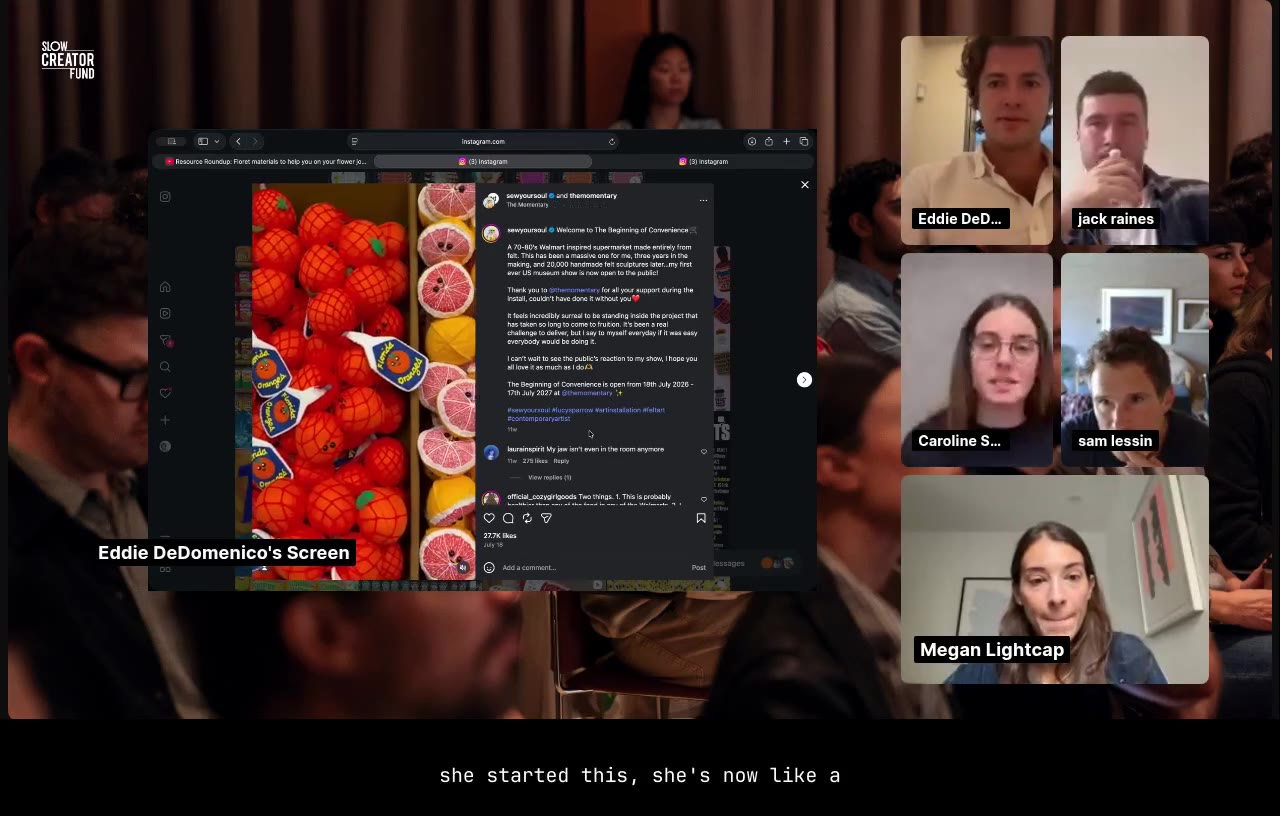
Caroline's pick, and the clip everyone reacted to most in real time. Lucy Sparrow is a British artist who builds entire felt-recreated environments — a full New York bodega ("The Convenience Store"), a pharmacy ("The Bourdon Street Chemist"), and other installations — every object hand-sewn from felt down to individual pill bottles. She started in 2017 with a New York bodega show and sold out all roughly 9,000 felt pieces that made it up; a second show in 2022 (framed in the call as "Tampa Fresh Foods") sold 35,000-40,000 individual felt pieces; and she's now building a new exhibition in Alabama with roughly 30,000 handmade works, running through mid-2027. Sam immediately compared the appeal to the earlier death-content discussion — this is exactly the kind of thing people get "weirdly obsessed with," where an individual felt object becomes a collectible identity marker (he drew the comparison to Jellycat-style plush collecting). Megan was the most enthusiastic reaction of the whole call ("I would pay money to go here... I might buy one"), and floated that this rhymes with Museum of Ice Cream — a ticketed, multi-city experiential format, not just an art sale. The group's live question: with tens of thousands of pieces selling out each show, who is actually buying the less-desirable/random pieces, not just the hero items.
1:44
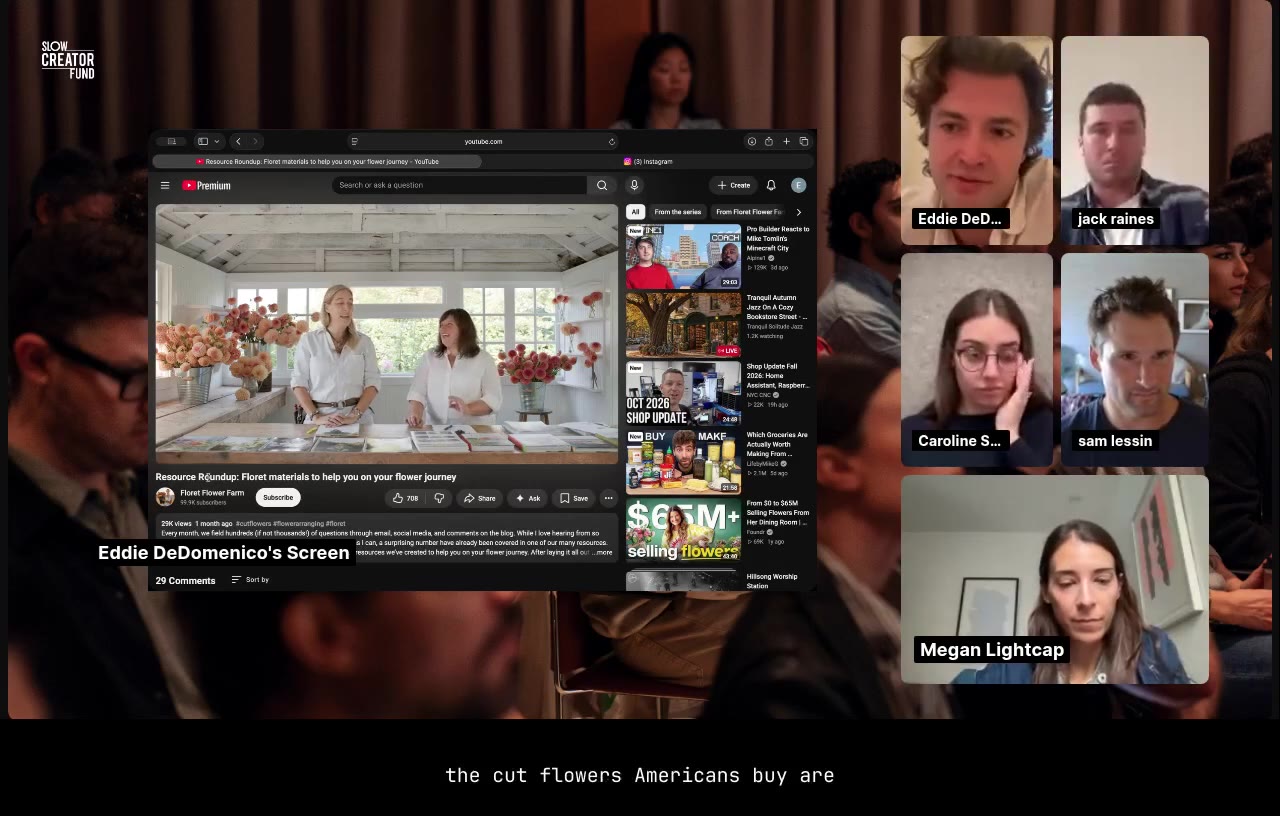
Eddie's pick (misheard on the call as "Aaron Benzakine, aka Florida" — real name Erin Benzakein, brand Floret). Eddie and Caroline had independently been excited about her before comparing notes. About 80% of cut flowers Americans buy are flown in from abroad, and Erin teaches people to grow their own — she's built a 1.3M-follower, fully bootstrapped business starting from a two-acre farm, breeding her own flower varieties, with NYT-bestselling books. Scarcity is core to the model: a $2,000 in-person workshop that sells out instantly, and a seed shop and online course that each open only once a year, creating sustained unmet demand. The one flag Eddie raised: materials reference 2027 as the last year of her full in-person guiding courses, which could mean she's scaling back or repositioning toward something bigger — unclear which. Sam's reaction was immediate and enthusiastic: people are clearly willing to pay for flowers/gardening in a premium, high-end way, and he didn't feel the need for more debate before green-lighting outreach.
3:06
Caroline opened this as a broader category question rather than a single pitch: homesteading is a crowded vertical (Ballerina Farm being the obvious giant), and the team debated how to identify the actual winner rather than just another entrant. Eddie is getting introduced to Justin Rhodes, who has over 1M YouTube subscribers teaching homesteaders and aspiring homesteaders, and separately built Abundance Plus, a subscription streaming platform/network (his own and other creators' homesteading shows) with roughly 4,000 paying members — a real community/marketplace layer on top of content. Eddie doesn't have fully formed views yet, but the raw membership number alone signaled real commercial depth. Megan reframed the category: homesteading is the mirror image of the "New York City influencer girl" lifestyle-documentation genre — a lifestyle choice being documented, not a true scarcity niche — and she's skeptical about winners beyond a couple of outliers like Ballerina Farm who manage to cross over to broader (urban/coastal) audiences. Her read: look for someone who, like Ballerina Farm, transcends the core homesteading audience rather than just serving it. Eddie separately floated the idea of a "Paige Lorenz of homesteading" archetype (a stylish, crossover-appeal figure) as more interesting than the 45-year-old, self-described "crunchy" homesteader he's about to separately meet with.
5:04
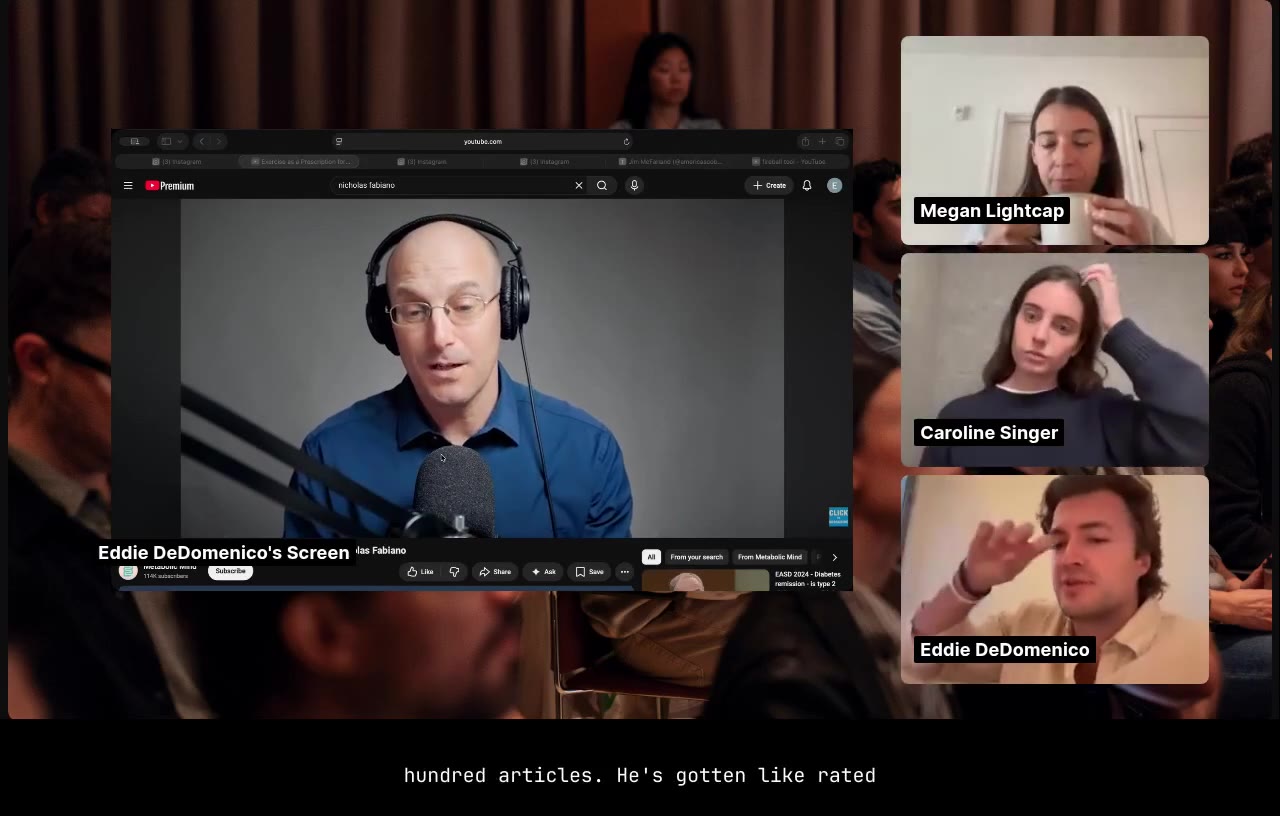
Eddie's pick, a direct follow-on to the Dr. Bruce meeting and the holding-company-around-experts idea: he went hunting for younger experts in the Nick Norwitz vein and found a 28-year-old psychiatry resident and researcher at the University of Ottawa who is 'so aggressively opinionated about consumer psychiatry' it's unlike anything he's seen. Roughly 1,500 Google Scholar citations, profiled as a rising star by Brain Medicine, quoted in the Washington Post and Fast Company. The category is lifestyle psychiatry: exercise, sleep, diet and creatine as the first line of defense, argued combatively on X (70K+ followers) in a very young, internet-savvy way — up to claiming that a psychiatrist who doesn't lead with exercise for depression is 'in the realm of malpractice.' No products or business yet; he's still finishing residency. Eddie wants to get in touch to see whether he'd start building — or dive in — knowing he's backed with capital and firepower. Megan agreed it's worth contact but wants to know who's actually in his core audience (especially if X is the main channel) and pushed that the broad lifestyle-wellbeing space is full of parroting experts, so be specific about what differentiates him; Eddie conceded today's differentiation is the energy and aggression, 'which doesn't necessarily make for a great business. It just makes them stand out.' On the James Clear question, Eddie: more clinical than that right now, 'but that's what this turns into.'
6:17
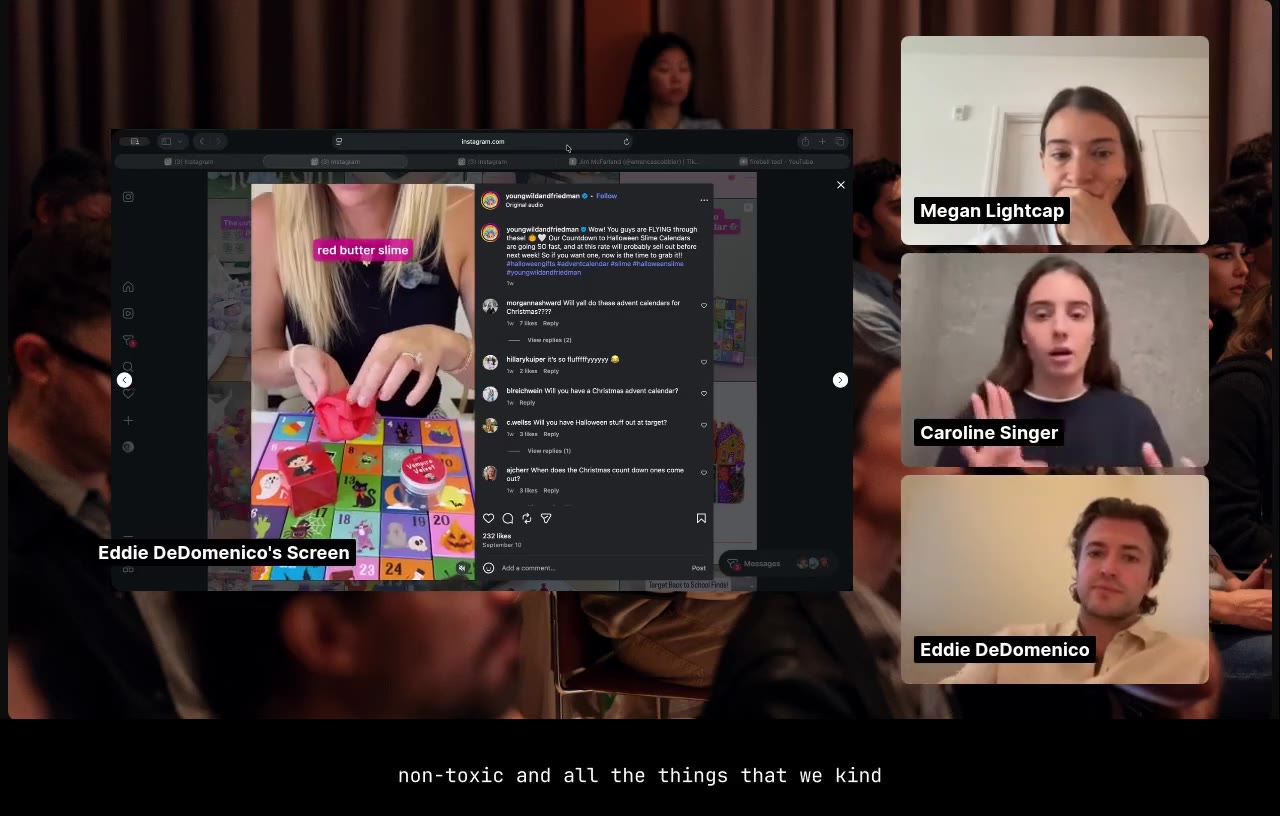
Caroline's pick — 'the Play-Doh Lady.' Julie started posting sensory-toy content when her daughter had speech and developmental issues, and it's grown into a real products business: themed kits (slime, play dough, sand bins) mapped to developmental milestones — motor skills, cognitive growth, problem solving, sensory awareness — all non-toxic and US-produced dough, sold as packages, with an exclusive Target line and a monthly subscription (rare recurring revenue in kids' toys). Caroline field-tested the thesis in an accidental postpartum-yoga mom group: there's real spend when parents panic about missed milestones, and the moms named Julie unprompted. Megan and Eddie both confirmed the organic reach — 'literally seventy percent of my young mom friends follow her' (Eddie), who sees it becoming 'part of the parenting stack.' Caroline also flagged her operational chops: warehouse videos, visible team, clearly a real operator rather than a white-labeler — so capital could go to growth rather than hiring ops. Versus the Speech Sisters and Raising Little Talkers (both massive but missing a wedge; the latter very course-dependent), she has the physical product plus the content distribution. Caroline sent cold outbound the morning of the call; Eddie has a plugged-in friend who follows her as a backup route, and Megan was checking mutuals.
6:08
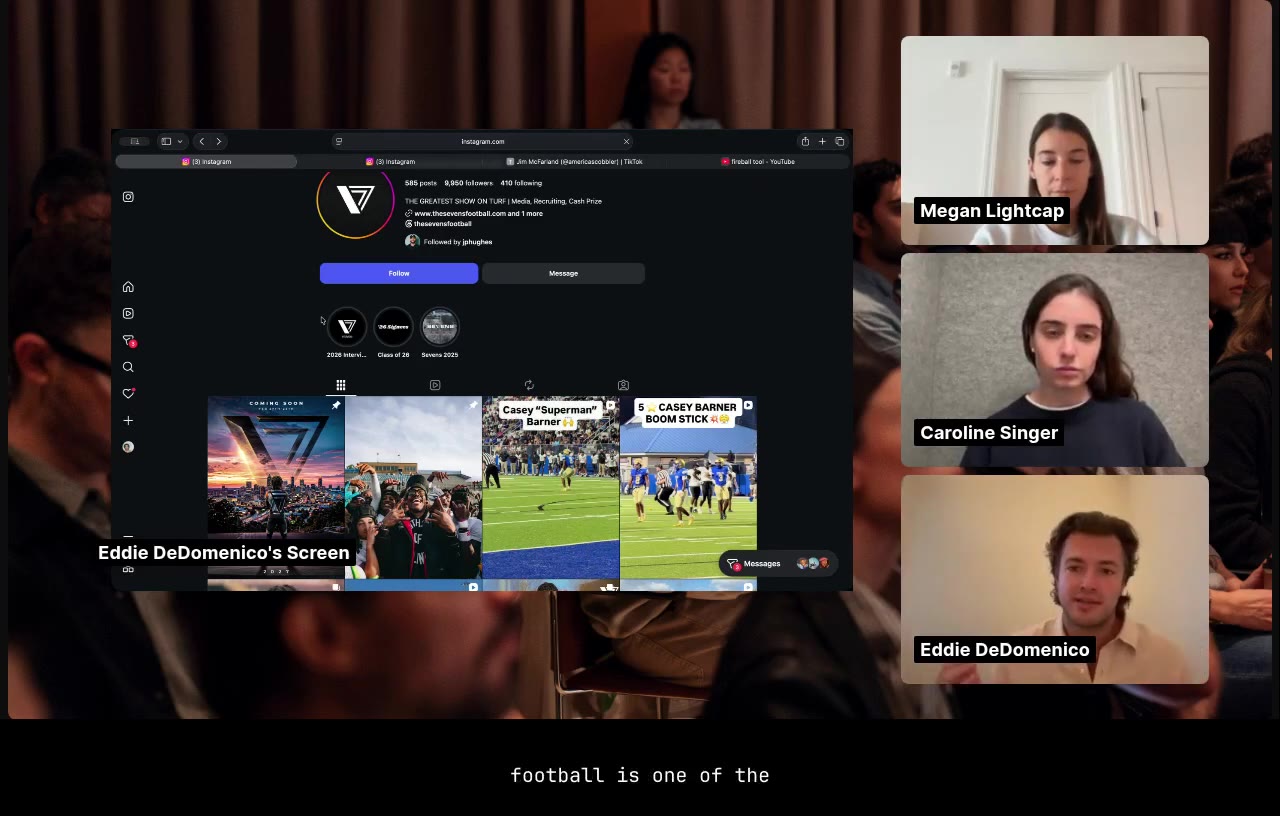
Eddie's continued pursuit of niche sports (he wished Jack were on to color-commentate). Youth sports has no traditional individual creators building businesses yet, but it does have digitally native brands with content flywheels — and elite 7-on-7 'notepad' football is the ripest recruiting proving ground in the high-school offseason. The Sevens was started by three NIL media-industry operators (most leagues are started by coaches who don't understand the media product). Invite-only, where top recruits get game tape college coaches take seriously, plus cash prizes and endlessly clippable viral moments. The Atlanta debut drew six five-star recruits, 70+ four-stars, 330 athletes holding D1 offers, coverage from On3 and 247Sports, and NFL stars who just wanted to be around it. Current business is nascent: ~$1,000 per team entry, $20K+ purses. The tech wrapper is what got Eddie: they're building or licensing AI-video 40-yard-dash timing ('The 40') captured during actual gameplay — today's 40 times are gear-dependent (flown-out laser rigs) or inaccurately hand-timed, so a camera-only capture is something platforms could license while The Sevens accumulates the best data in the space. Megan's pushback: they seem subscale for the claimed network, it's 'just a brand' without a creator at the center, probably a little early — but worth talking to. Eddie's counter: there's a built-in micro-influencer network (recruits with 5–20K followers posting from events, plus distributed assets), and the only way into these is early. Eddie is already in touch.
6:51
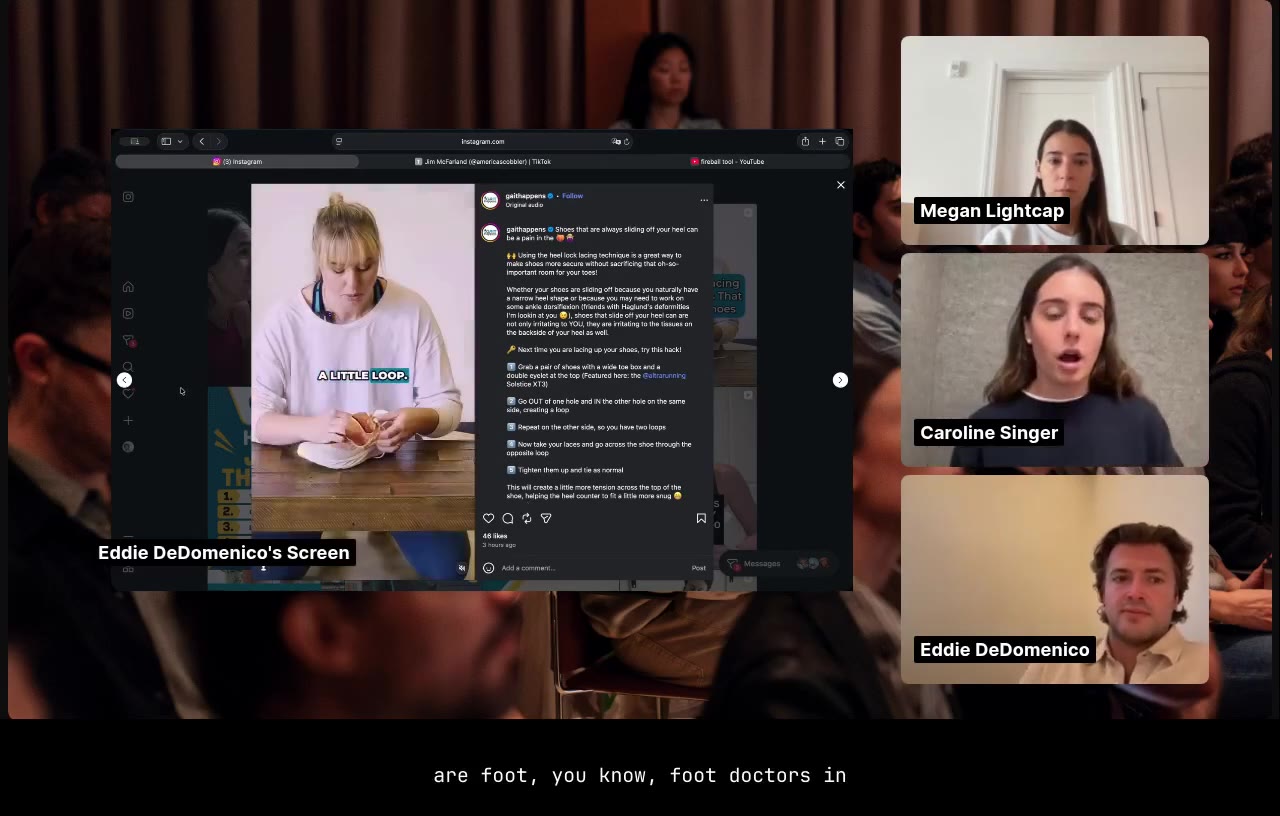
Caroline's pick, deliberately narrower after last week's 'slightly too broad' conversation: find credentialed experts in a defined niche that still has a big TAM. Gait — how feet, ankles and hips work together when you walk — affects balance, mobility and how stress distributes through the body. Gait Happens is foot doctors (the public face is Dr. Courtney Conley) with ~350K followers who built infrastructure around improving gait: consumer products on their own site (toe spacers, strengthening bands, mobility tools), virtual consultations, online programs, professional education, and an in-person walk event. The aging angle is core — balance and mobility deteriorate with age, and there's a natural physical-therapy channel. Megan compared it to Knees Over Toes, 'a sneaky big business,' and wants the community dynamics understood (one-to-many vs peer-to-peer) — plus a sharper way to read engagement on informational content: shares and bookmarks over likes, since people send this to friends, parents and doctors. Eddie is personally deep in it — he does daily foot exercises after athlete friends lost their arches and wrecked their backs — and framed it as not-quite-a-silent-killer that nobody attends to 'until you're basically too far gone,' with consumer kinesiology getting bigger overall. Open puzzle: viewership looks decelerated — what originally popped for her (Megan wants to see growth pops from big podcast appearances)? Caroline sent cold outbound the morning of the call.
5:16
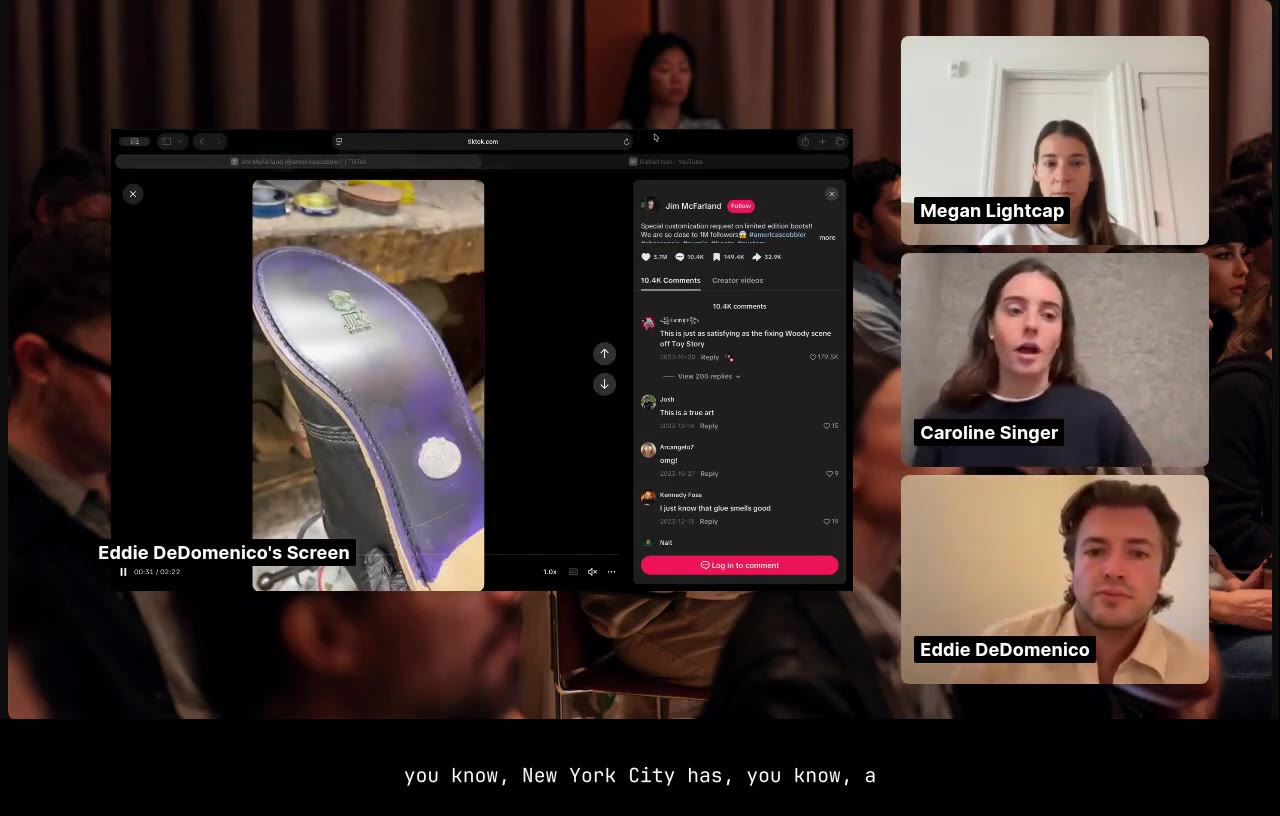
Caroline's pick and the consensus favorite — Eddie: 'the runaway in this session.' It started with Phil's wedding shoes: a nameless West Village hole-in-the-wall saved them, and Caroline realized the whole trade is anonymous mom-and-pops — you go to 'your local cobbler,' there's no brand. Jim McFarland is the exception: 1.5M on TikTok, nearly a million on Instagram, restoration/transformation content with strong engagement, and a real operating business — McFarland Shoe Repair in Florida, where people ship shoes from all over the world, plus the 'America's Cobbler' line of DIY shoe-care products (cleaning, conditioning, waterproofing — Uggs, designer soles). Caroline's frame: fragmented like piano technicians and ripe for a nationally recognized go-to name — scale the team, footprint, or hub-and-spoke mail-in. Megan loved it: with local cobblers 'you're heckling over price, you have zero idea what the quality is gonna be, you basically have to pay up front in cash' — a true craft/trades business where a trusted brand is really interesting. Eddie is an avid cobbler-goer (a boots guy spending $150 twice a year on resoles). Caroline's adjacent angle: a pipeline with TheRealReal/Fashionphile — buy discounted distressed designer shoes, refurb through him; Megan went further: he could list refurbished inventory himself, the best 'as-new' source. Caroline sent cold outbound (his LinkedIn is faceless and inactive — 'only the Dr. Sethi types are active on LinkedIn'); Megan has mutuals to activate if he doesn't answer.
2:22
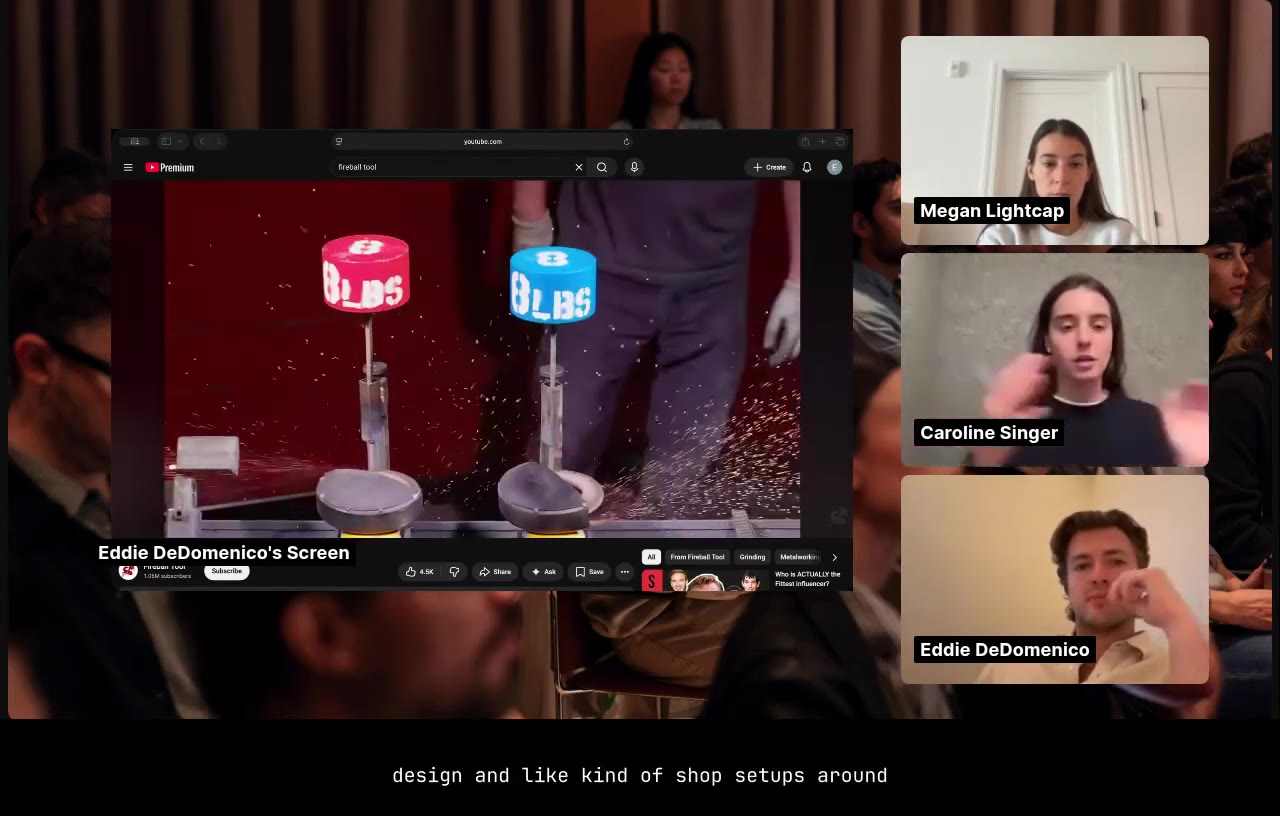
Caroline's second skilled-trades pick, answering a standing question from earlier conversations: welding requires certifications but isn't a licensed trade. Jason has built Fireball Tool into a highly trusted brand with welders, fabricators and DIY learners — problem-solving education, tool design and shop-setup content around the metal-fabrication ecosystem, where he demos his own proprietary products (welding fixtures, tables, squares) in real working environments: a natural educate→use→sell flywheel. It already looks like a proper global business — US and EU customer service — while the YouTube keeps scaling ('people show up in mass to watch these videos'). The macro thesis: tradespeople and fabrication are taking off as AI data centers get built. Warm paths exist: Megan noted portfolio creator Jonathan (Katz-Moses) follows him ('so classic'), and Eddie is already getting looped in via one of his customer-service-play contacts and will bring Caroline along. The discussion closed with intro hygiene on asking portfolio creators for connections: fine to float, but try other routes first — bothering portfolio creators is the last-ditch move.
6:48
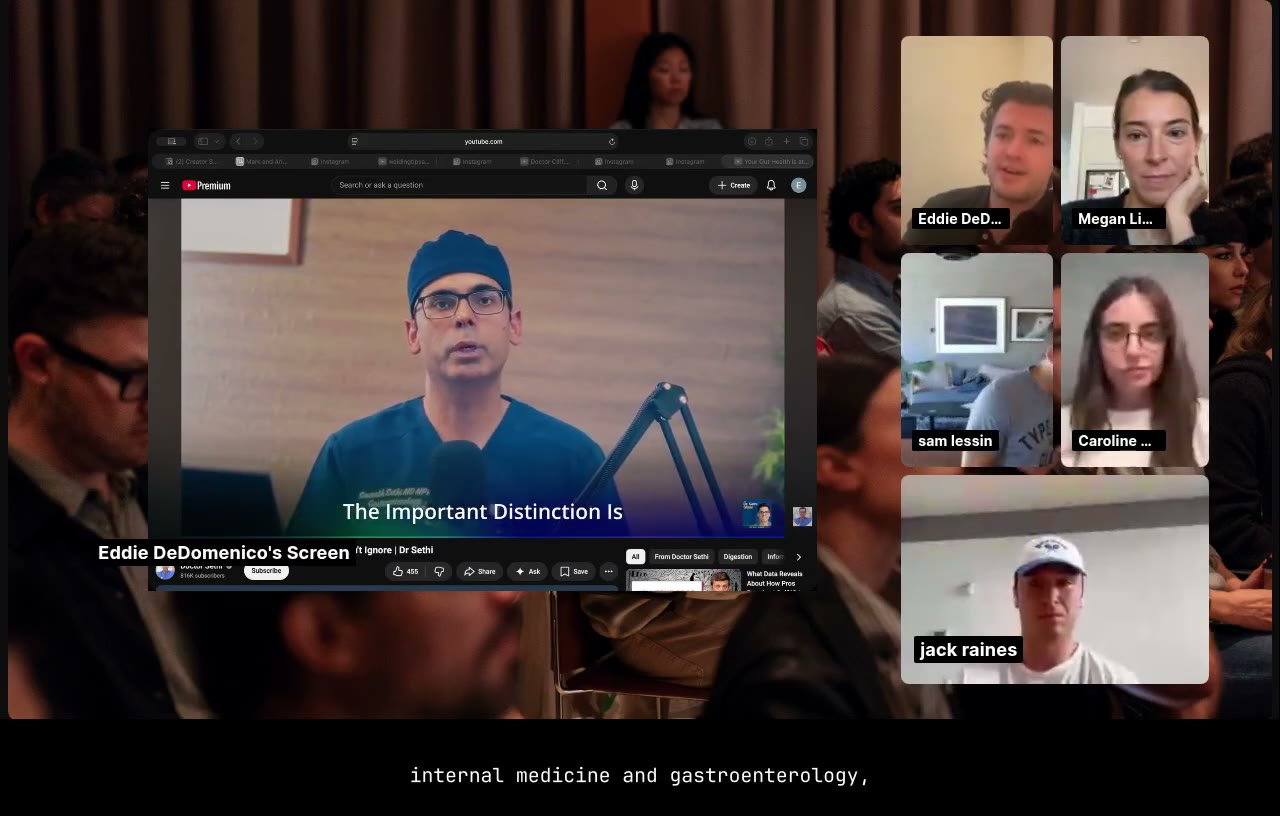
Practicing gastroenterologist, double board certified in internal medicine and gastroenterology with Harvard and Stanford training, ~3M followers. Eddie's read: the credentials aren't decorative, they're the entire moat in a category drowning in guesswork and fake influencer information. He spent a year finding his own bloating triggers and built the app he wished he'd had, which runs the same structured protocol he uses in clinic: users photograph meals, log symptoms, and get an adaptive weekly plan across IBS, reflux, constipation and fatty liver. Content formula is deliberately basic funnel-building — ranking 10 snacks, 10 sweeteners, 10 drinks — to pull people into the system. Eddie thinks the app is just the wedge and the real opportunity is fatty liver: roughly a third of adults have it, almost none know, and it's becoming a major drug market. Megan pushed that 'bloating' is a symptom, not an entry point — he needs a more specific on-ramp (her analogy: 'I'm itchy' vs 'I'm itchy because of eczema'). Caroline noted only two people are using YouTube effectively as a funnel in this space and she's reached out to both.
2:22
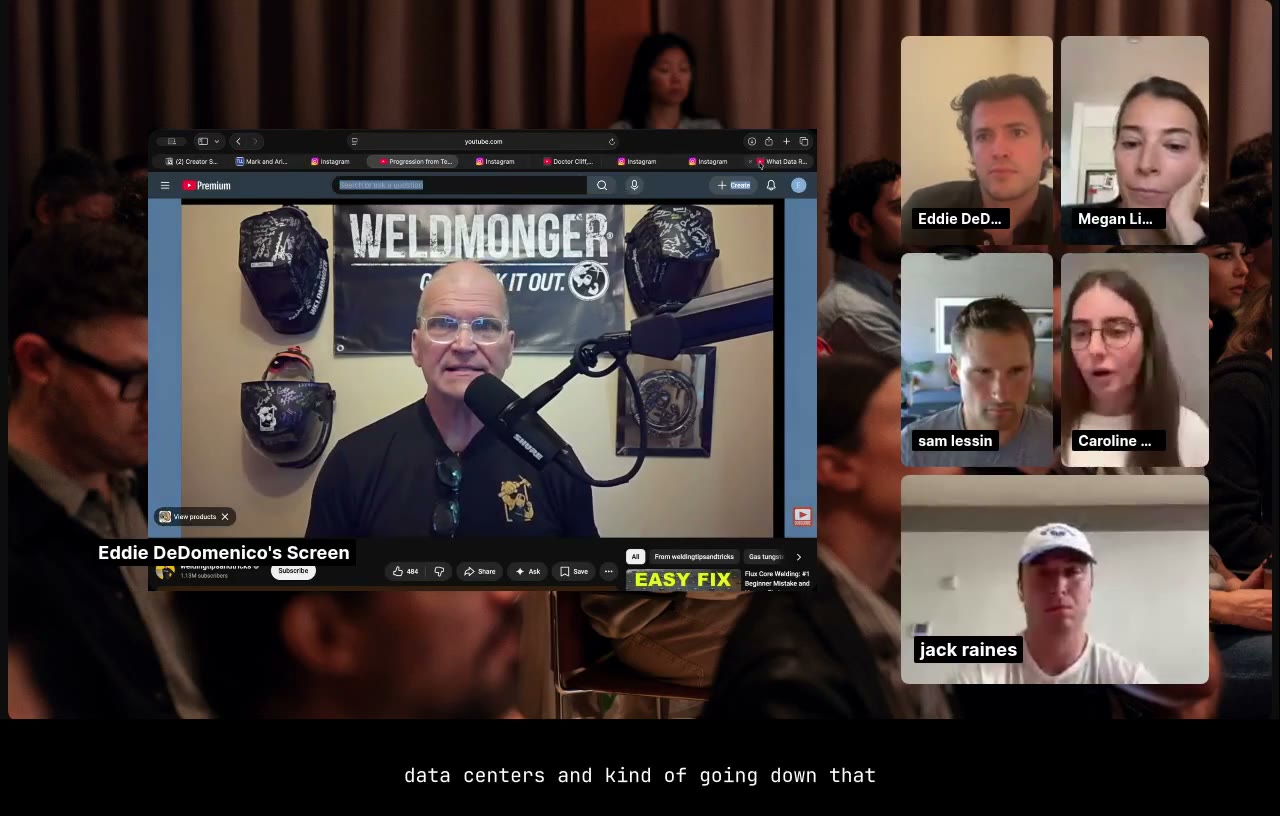
Welding expert who produces training content, product demos and industry coverage while designing and selling his own proprietary welding tools through his e-commerce platform. Caroline brought him as part of her running skilled-trades thesis, this time sharpened by a conversation with Alan at Revival about welding in bike manufacturing that led to data centers: data-center construction is welding-intensive and only getting more relevant. Her core attraction is that he makes proprietary tools rather than reselling third-party equipment — owning the category as it grows while the content demos create a natural flywheel. Sam likes the area but flagged that welding is licensed and union/guild-organized and hard to do well, which is worth understanding before going deeper. Caroline admitted skilled trades has been her hardest category for actually getting anyone to respond or get on the phone, and will add a licensing/education filter to her search.
5:03
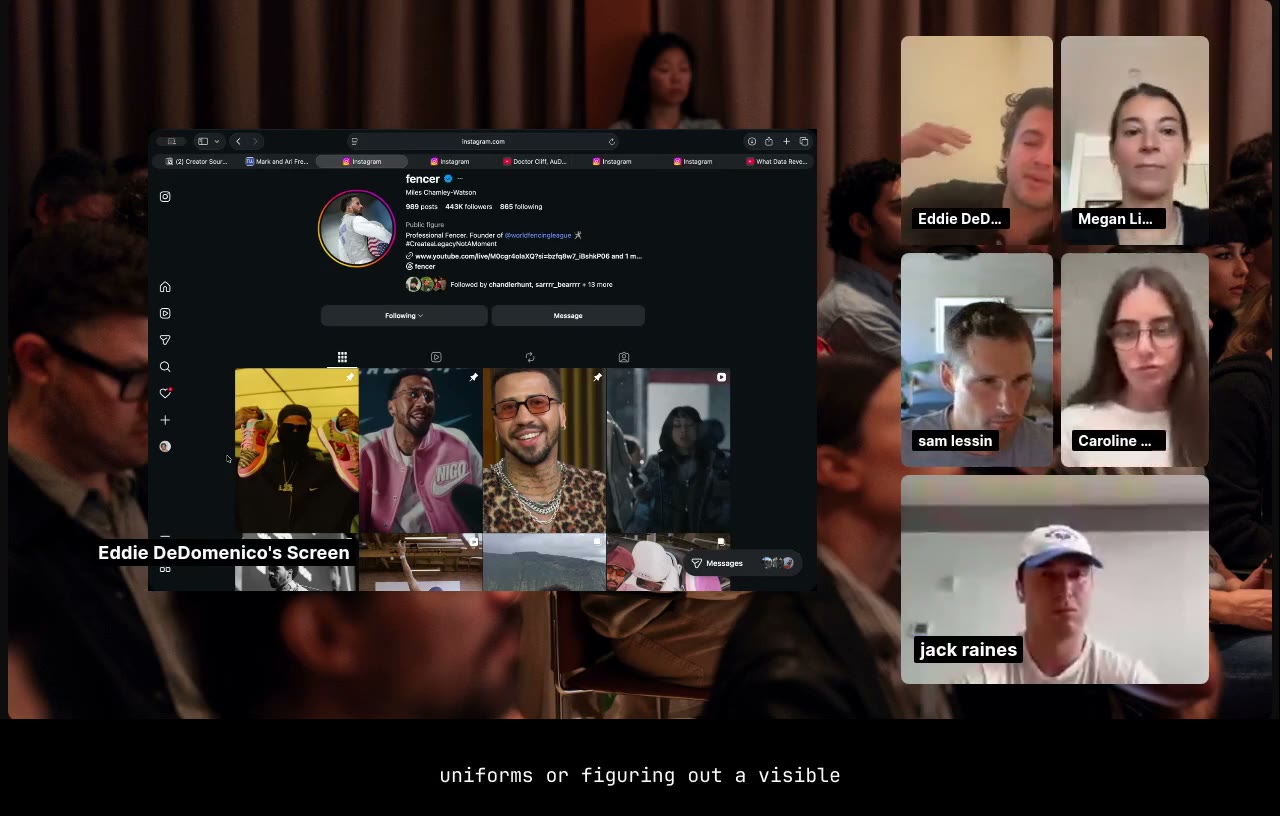
Eddie's out-of-the-box niche-sports play: Miles Chamley-Watson, three-time Olympian, the first American man in a century to win an individual world championship and the first Black world champion in fencing — also a genuine fashion/culture fixture (Met Gala, Vogue parties, Fashion Week, a Richard Mille endorsement). He has been publicly arguing to change the sport's aesthetics and TV-friendliness (uniforms, visible scoring), and now he's founded the World Fencing League: its first event this year sold out with thousands attending, more events are scheduled including China, and NBC and DAZN are reportedly on board for TV licensing. Eddie's frame: F1 DNA — people come to drink, socialize and be fancy while an elite sport runs in the background, similar to where padel is trending — and there's no incumbent pro league to displace outside the Olympics. He compared it to Paul Rabil coming into lacrosse as 'the LeBron of the sport' who both played and drove the business, and sees WFL as a candidate piece of a future niche-sports roll-up as PE money pours in. He's raising to move aggressively; Eddie says he has legitimate operators around him. Sam: 'I don't hate this... this could be cool.' Caroline flagged she thinks she saw family-office backing, so verify whether the league already has outside capital.
4:11
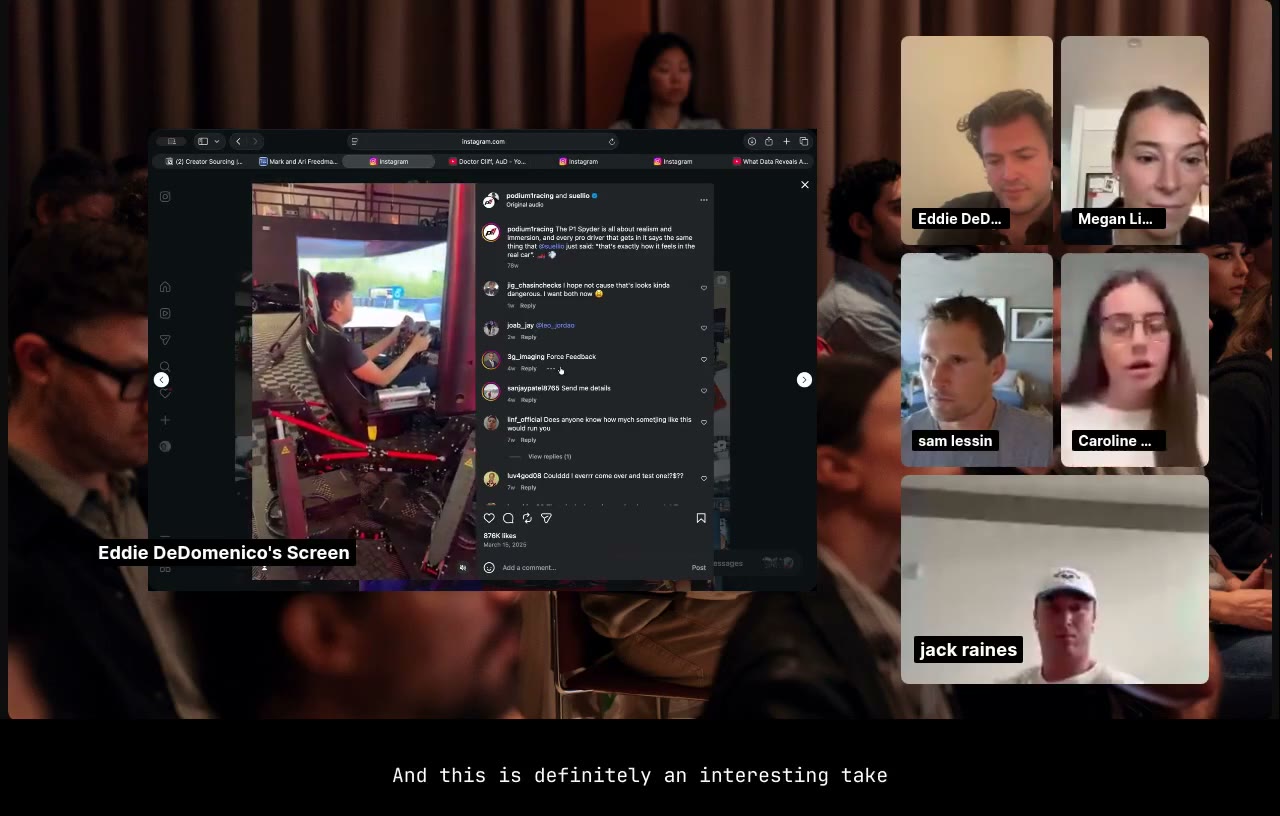
Caroline's infrastructure-not-creator pick: a company building elaborate racing-simulator installations — motion seats, wraparound screens, integrated software — for gaming laboratories around the country and private homes, now expanding into flight simulators. The idea came from seeing two of their rigs in constant use at Ares' new build-out, and the brand has ~500K social following with NASCAR-driver endorsement (pros actually train on them). Jack pulled up the site live: ~20 units, flight sims running roughly $40K to $120K ('these are sick... this is a good Lessin boys Christmas present'). Sam's reaction: thematically, simulators and sim-world are interesting (golf is precedent), but the open question is which part of the stack is valuable — building the rigs, or the league/community racing around them — and whether these are 'the best' at it. Megan wanted the Topgolf comparison run. Caroline connected it to childhood gaming-truck birthday parties: the party/corporate/event use case could be a whole additional layer beyond home installs.
5:04
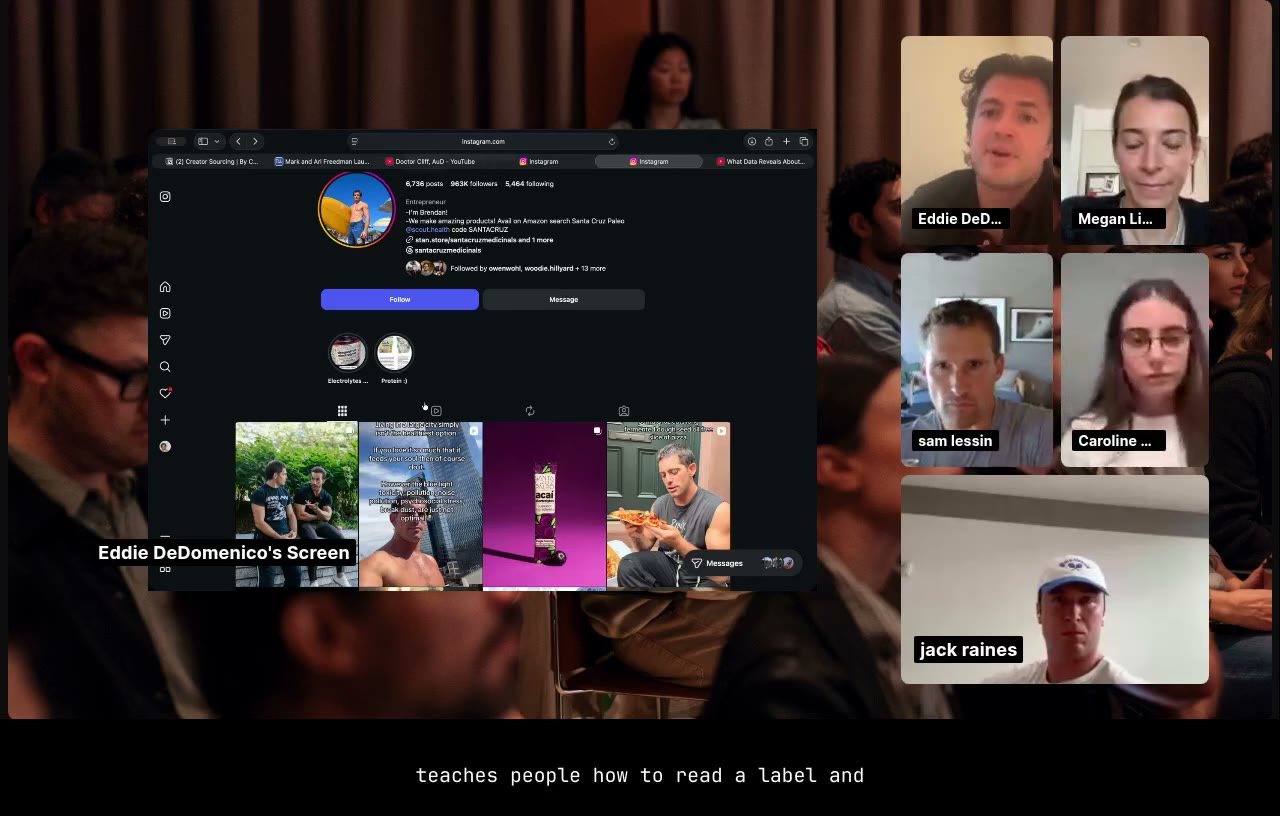
Megan flagged him after hearing friends 'would buy anything he recommends.' A former medical-anthropology student turned 'ingredient literacy guru': he teaches people how to read a label and audit a grocery aisle, and turned the following into Santa Cruz Medicinals — founded 2018 around CBD, now centered on paleo-space better-for-you products like creatine and electrolytes, reportedly doing very well DTC with no outside funding. The cult is unusually deep and skews 18–21: he got thousands of high-schoolers petitioning for an extra hour of outdoor time ('touch grass'), showed up in person, and was performatively arrested during a nutritional lunch break at a local high school in March — while also counting major UFC fighters among his devotees. Jack's riff: he looks like 'a sitcom character that got dropped in 2026... Billy Mays' nephew' — old-school infomercial energy that could sell anything, a type that doesn't exist anymore. Megan's comps: Justin's Ingredients and FlavCity, both doing an estimated $150–300M revenue — these things can grow extremely fast when the product is real and hits the zeitgeist. Eddie has tried ~6 emails; next moves are LinkedIn spam and the brand's customer-service inbox.
2:49
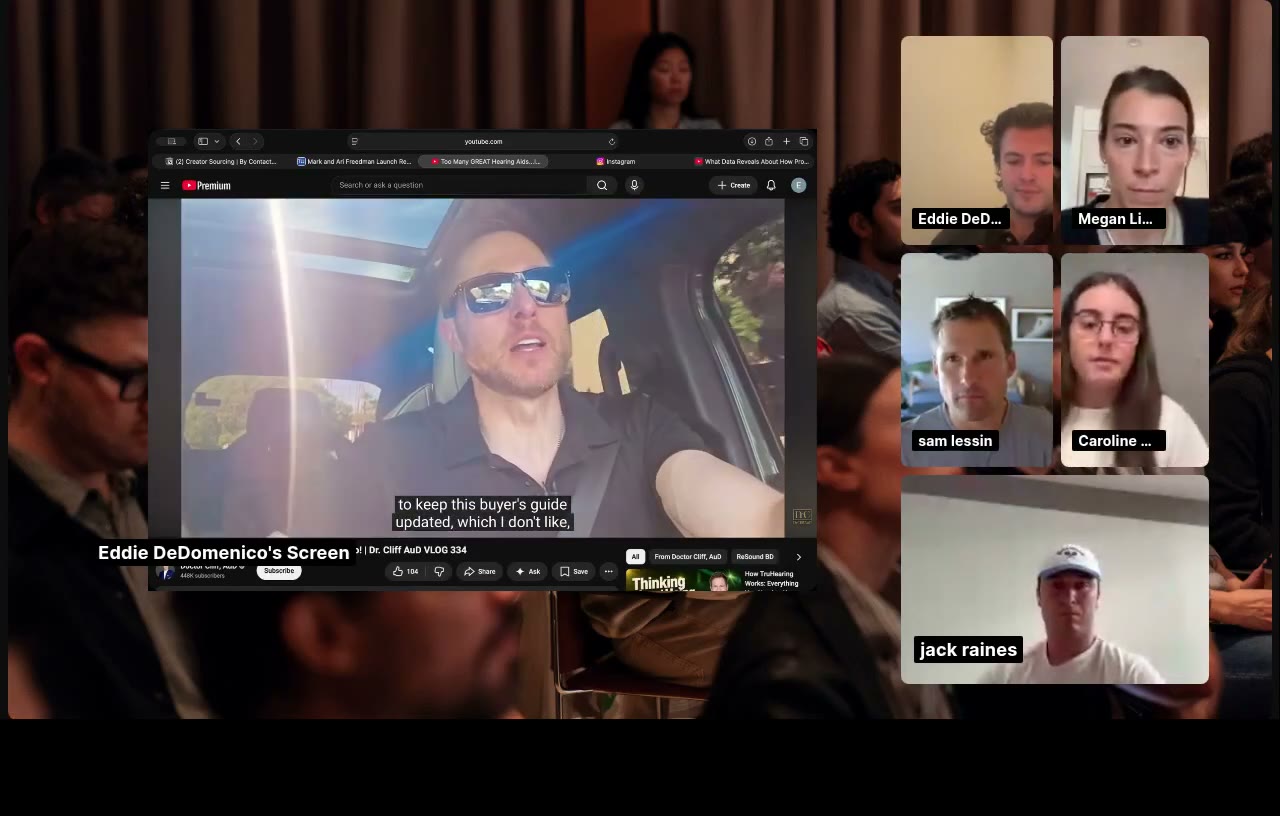
Caroline's pick: an audiologist focused on adults with hearing loss, hearing aids, their caregivers and consumers seeking audiology care — ~340K YouTube subscribers (the call said 'almost 500K'; live count is ~340K with 58M+ views), his own practice (Applied Hearing Solutions, Phoenix), and co-founder of HearingUp, a network of professionally vetted audiologists who pay to be in it after he vets them. Her thesis: hearing is a dated health category overdue for a rebrand, more resources and updated technology. Sam was into it and offered diligence angles: a buzzy new Silicon Valley hearing-aid product he can look up, and an ex-Facebook colleague who bought, built and sold a hearing company — worth checking where Cliff actually sits in the ecosystem. Sam's bigger frame: this is a huge issue, an interesting AI moment for the category, and hearing aids are 'so expensive' — Caroline extended it to a broader pattern she's tracking (her dad is legally blind): stagnant accessibility categories with one or two dated resources where next-generation businesses can capture near-infinite willingness to spend.
4:50
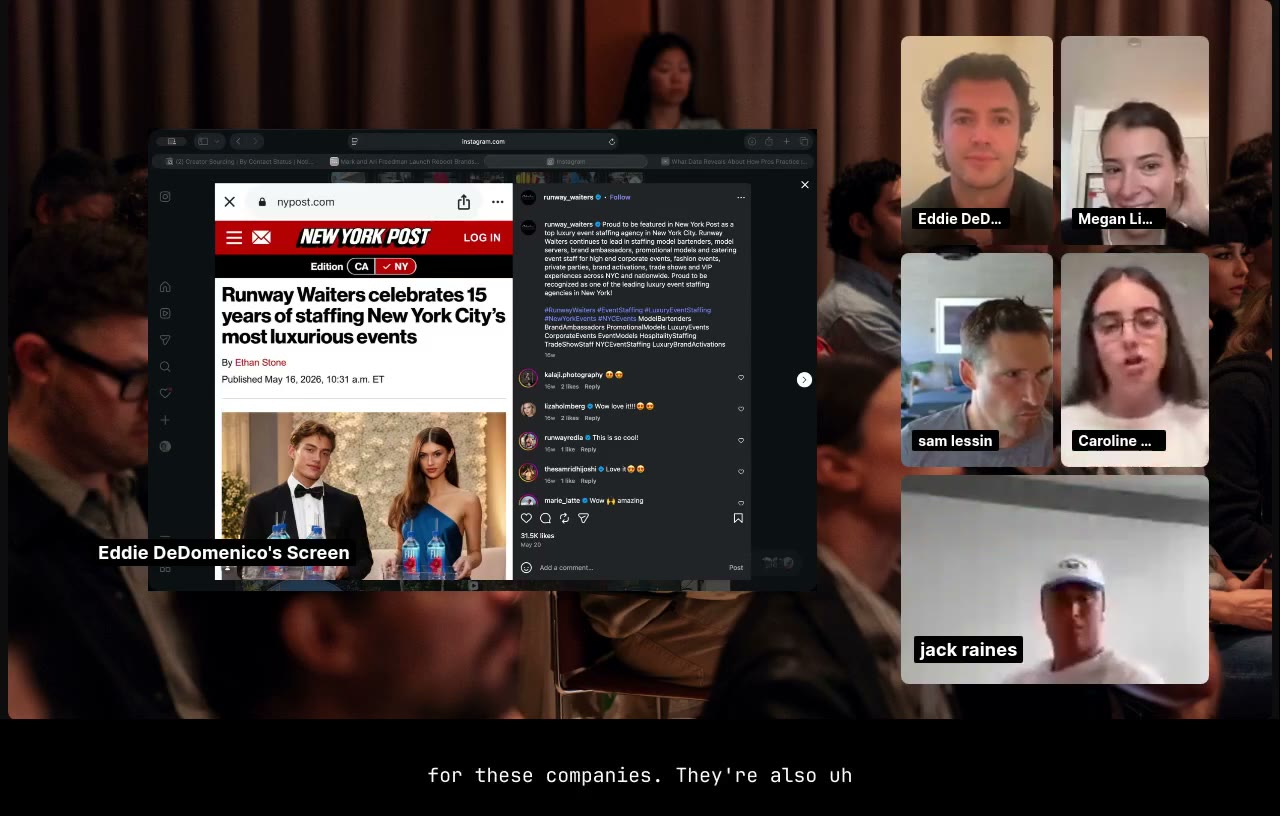
Caroline found it going down the high-end household-staffing rabbit hole: an agency that staffs luxury-brand events with professional models as waiters, servers and brand-launch faces, plus an adjacent influencer-marketing arm, Runway Influence. Megan called it 'a genius company' and connected it to the influencer product-seeding economy — hot delivery guys hand-delivering products for unboxing videos — extending naturally to Christmas parties and weddings in a world where everything is photographed ('you don't want, sorry, ugly waiters there'). Jack's macro take: this is the bull case for looksmaxxing as a real market — he used to think it was a bit until he met too many 23-year-olds who treat it as career strategy ('AI is gonna take the jobs... so I just have to be hot'), citing comedian Amanda McCants building a whole 'just be hot' rage-bait platform. Eddie grounded it in restaurant precedent: Great White in LA (about to open its seventh location, ~$40M revenue this year) launched by hiring only models, creating a halo effect people wanted to be around — same playbook as Abercrombie, and Jack added Corgi ('the Abercrombie & Fitch of Silicon Valley'). The team joked the idea should be fed to Clavicular to run.
7:54
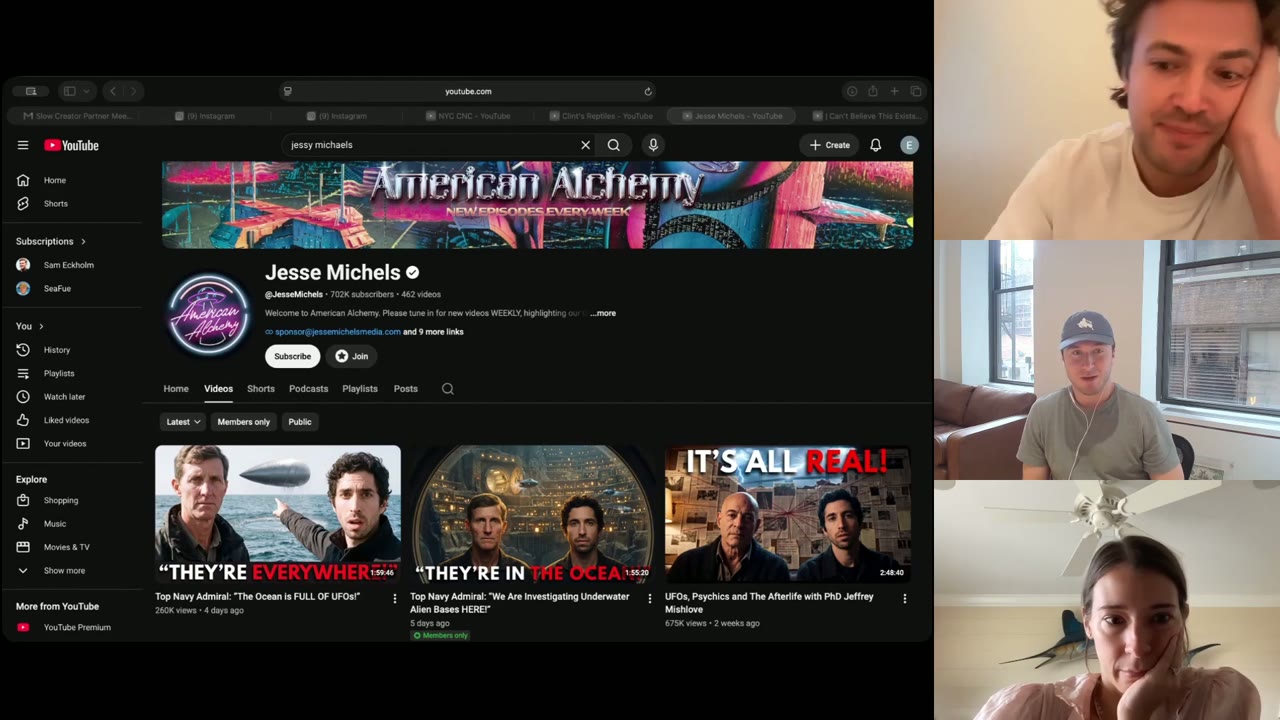
~700K-subscriber YouTuber interviewing UFO whistleblowers and skeptics; ~90% completion on 2-3hr videos. Ex-Peter Thiel family office (7 yrs). Ambition is to become a 'Cabela's meets doomsday prepper' retailer, starting with a physical preparedness kit. Currently monetizes on ads only. Newly signed by manager Chris Jackman, who is pitching the kit direction to Slow.
8:01
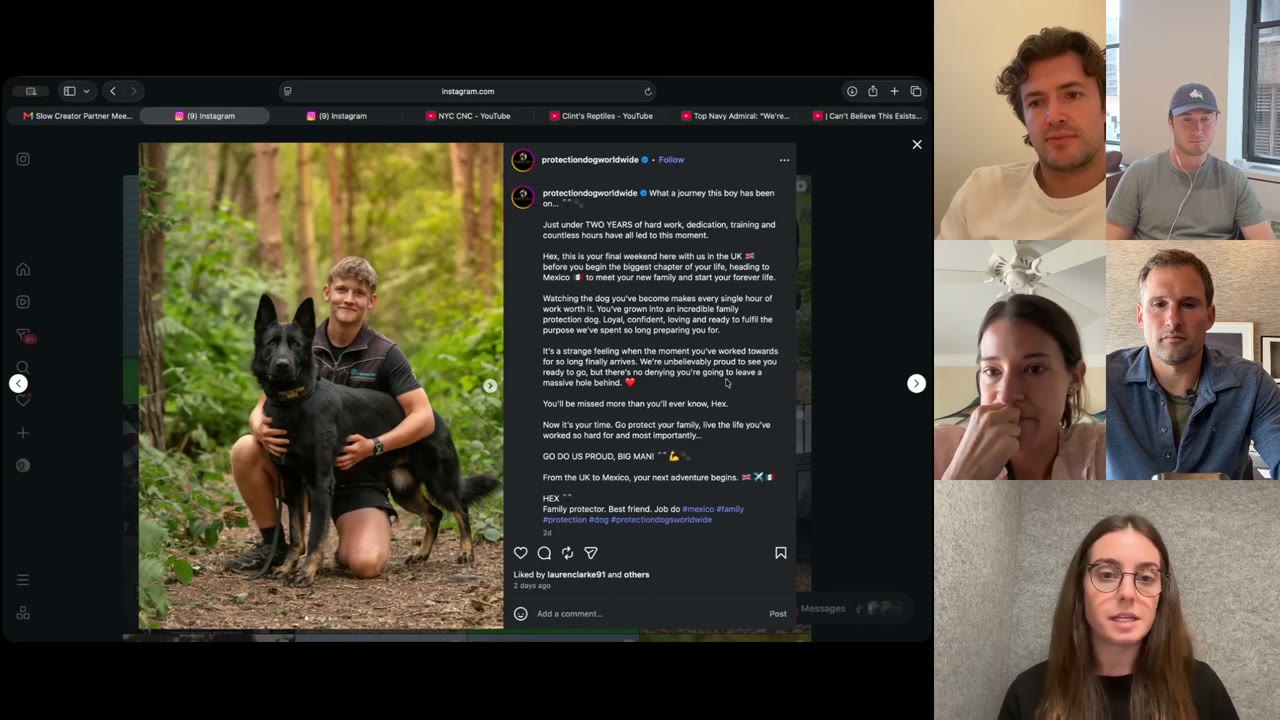
Trains and sells elite protection dogs to wealthy clients (FIFA president in their network, pro soccer players, LA/CA affluent) as family companions and/or a security alternative. Full concierge model: flies the dog to the client, a trainer stays a week in-home for integration, plus ongoing kenneling/boarding, multi-property patrol coverage, and a retirement program for aging dogs. 150K followers and growing; no pricing shown publicly.
7:29
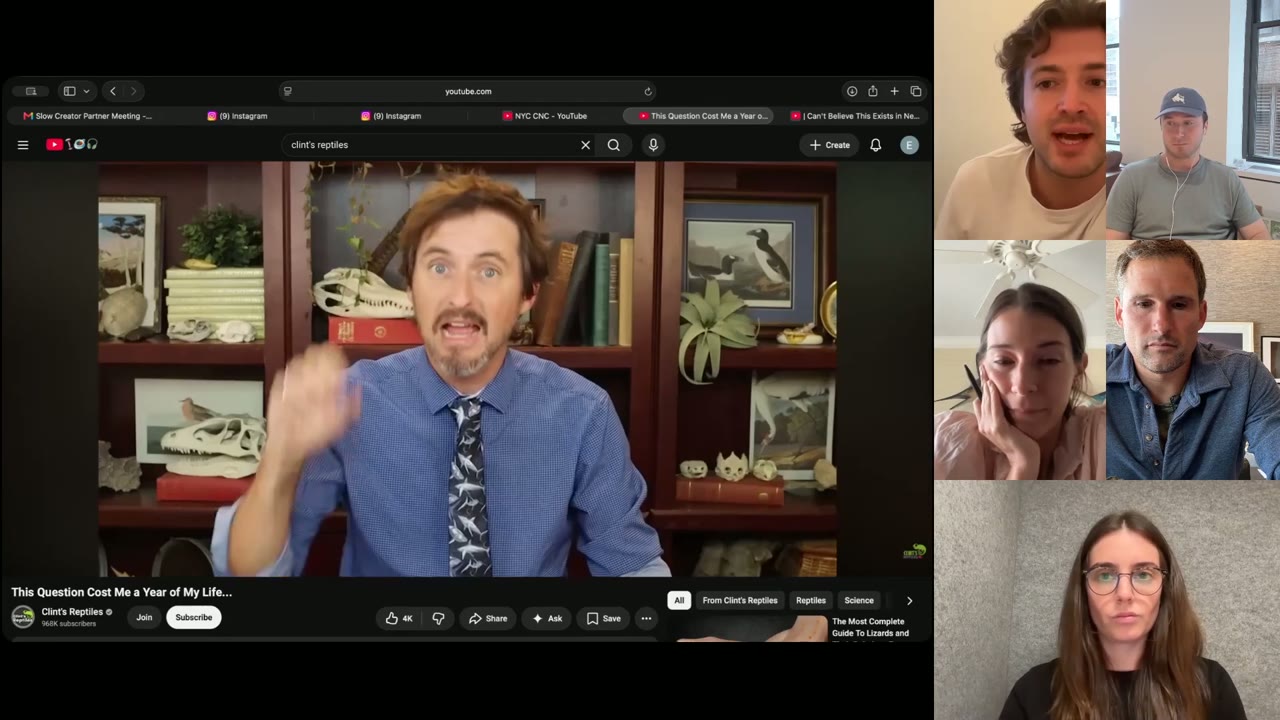
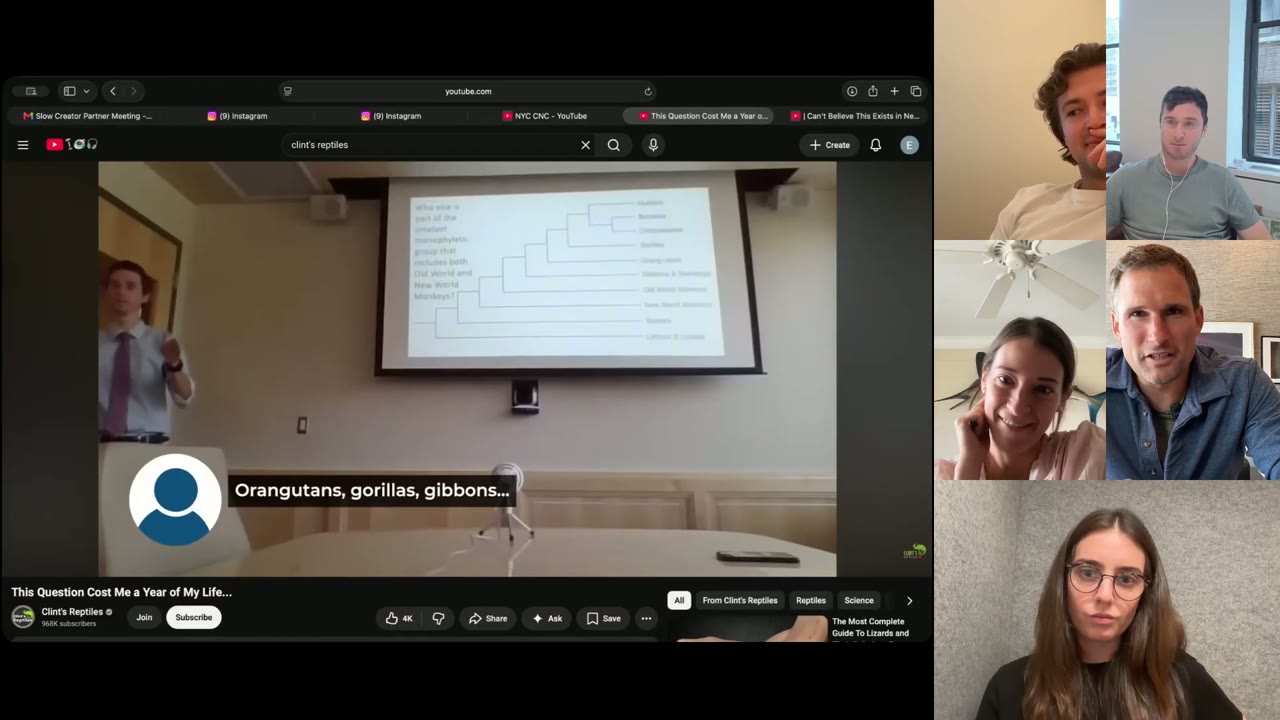
Biology PhD who runs a walk-in reptile education venue with his wife in Springville, UT (drives real tourism to a small town) plus a ~900K-subscriber YouTube channel mixing family/educational content with a working viral format (reacting to snake-bite videos). Speaks at universities and other reptile venues as a recognized expert. Monetizes via tickets, YouTube AdSense, and Patreon -- no product line (cages, lighting, food) yet, which the team sees as clear white space. US reptile-owning household base is ~6M and growing, with Gen Z roughly a third of it.
4:37
The dominant marketplace for buying, selling and trading snakes and reptiles, reportedly high-margin. Not creator-led -- flagged by Caroline as possibly the more directly investable node in the reptile vertical than any single creator. Appears to be single-owner; ownership structure not yet confirmed.
5:19
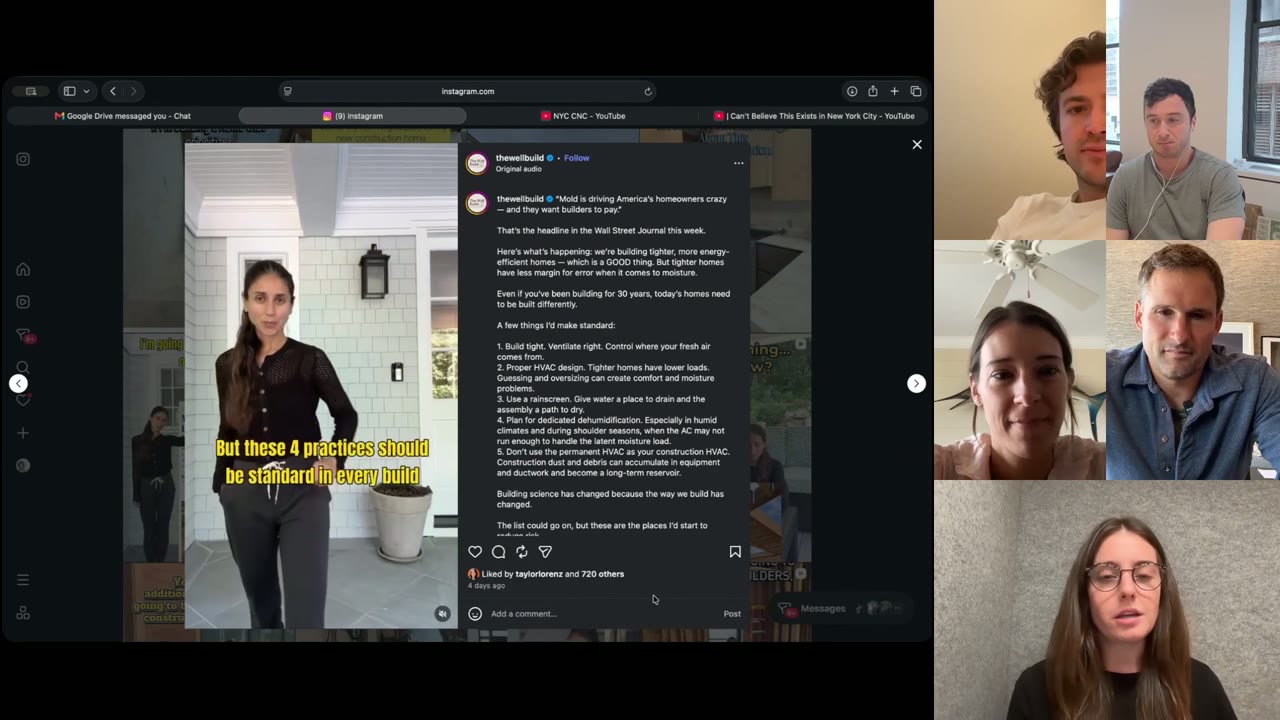
Consulting brand around healthy, non-toxic home construction. ~83K Instagram followers, adding ~10K in the last two weeks alone. Tiered model: ~$10K in-person consulting during a build (mold, EMF, water quality, materials assessment, works alongside contractors), a cheaper $1K+ remote-consult tier for people about to build, and direct product sales (e.g. $3-4K water-treatment systems). Caroline has a scoping call scheduled for this Thursday.
6:41
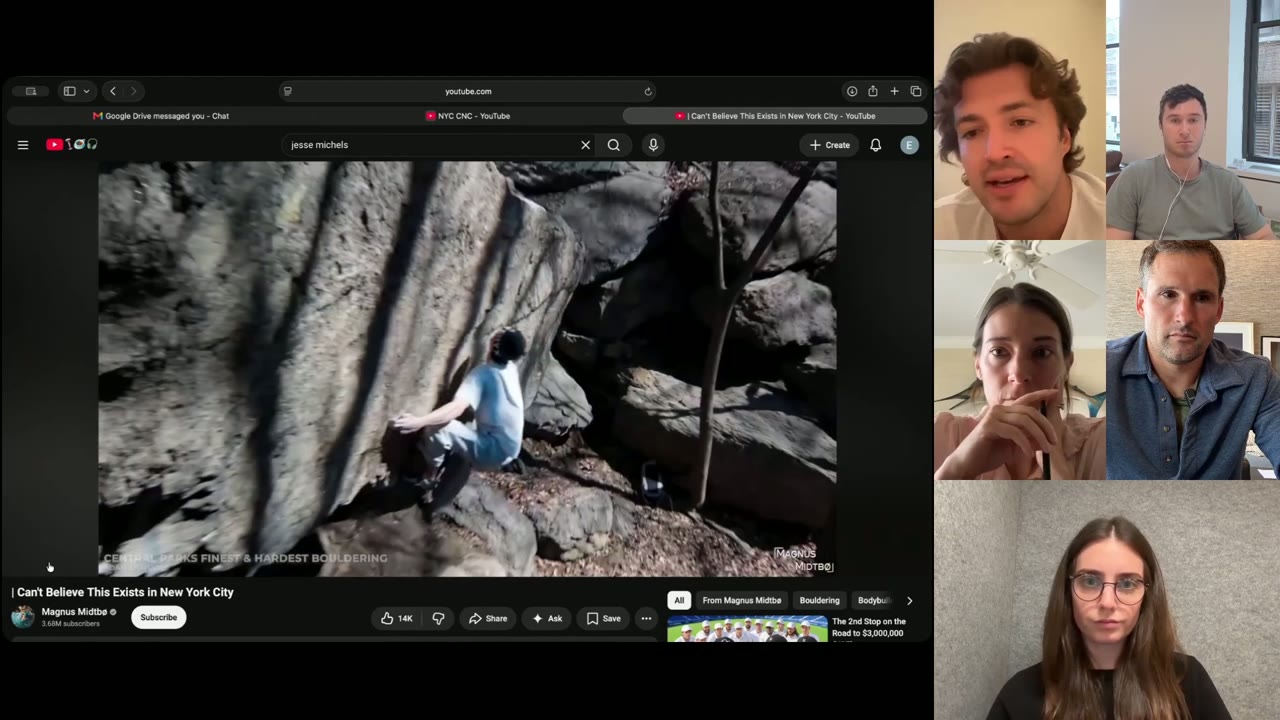
Norwegian ex-world-champion competitive climber (retired from competition 2017), now the largest climbing YouTuber globally (3.7M subscribers) with engagement per video still scaling year over year. Owns Rungne, an apparel brand whose real revenue driver is B2B chalk sales into climbing gyms -- reportedly $5M in 2024 sales, presumed accelerating. Also owns a rock-climbing gym in NYC with plans to expand the gym format.
2:28
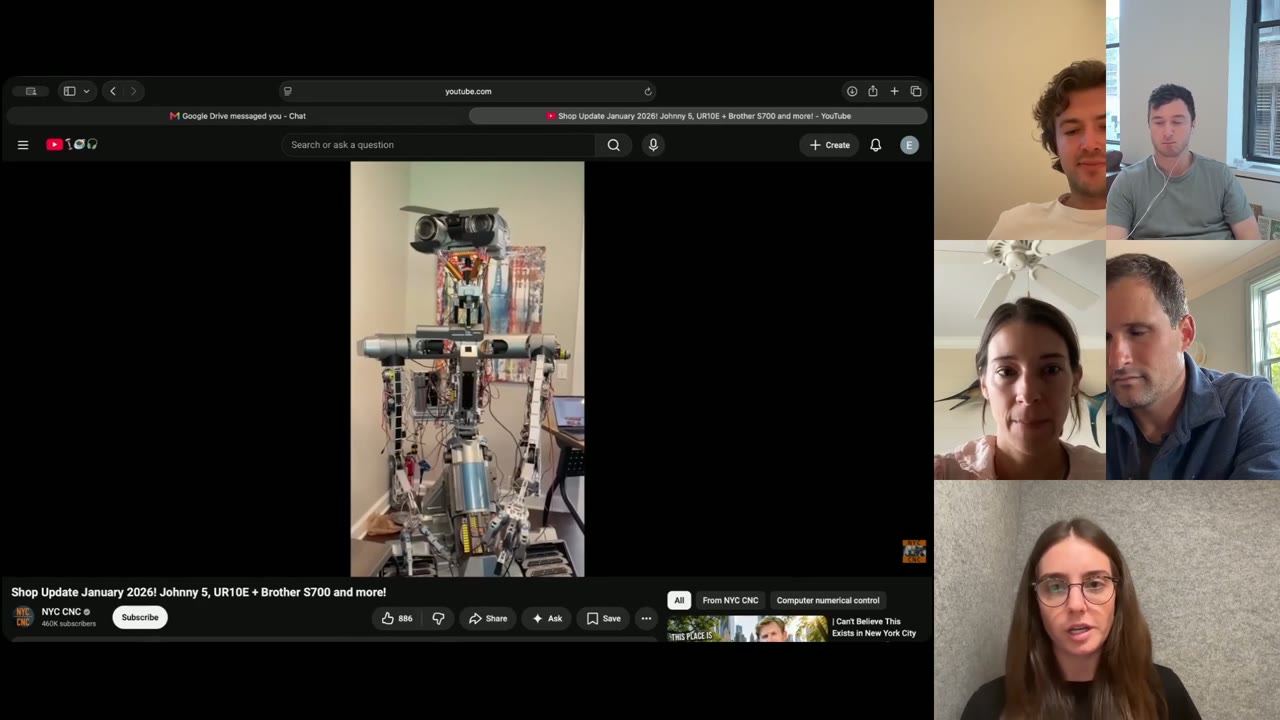
Saunders Machine Works runs a physical business making CNC tooling products (fixture plates, zero-point work-holding systems) alongside content, serving both hobbyist and professional CNC buyers. Titans of CNC is the biggest educator/name in the category but reads as pure-education rather than product-and-commerce -- Saunders looks more entrepreneurial by comparison because of the attached physical goods business. Opaque, hard-to-navigate market for buyers, which the team thinks creates real value in becoming the trusted authority.
4:31
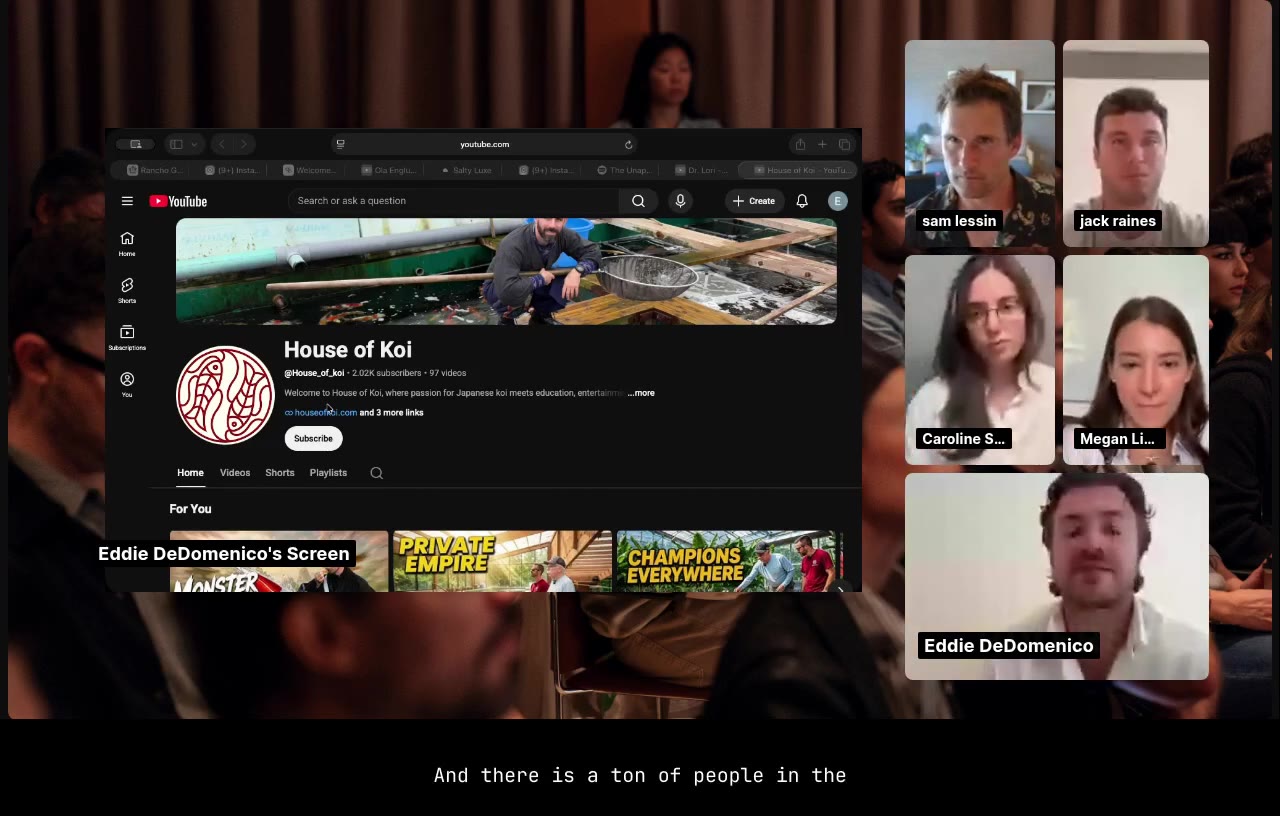
Miami-based founder who lived in Japan for three years (studied in Kyoto, fluent) and is one of the few Americans buying directly from top Niigata koi breeders, reselling DTC at $79-$2,200. YouTube is tiny (~2K subscribers) but a recent video hit 63K views and he's a genuinely good storyteller; content is koi unboxings and pond builds, which is the acquisition channel. Eddie's thesis: the koi is the top of the funnel and the real business is custom pond design plus ongoing servicing for wealthy owners, which runs 20-100x the price of the fish (the 'plant daddies' playbook). The hobby is deeply institutionalized (clubs, ZNA chapters where he speaks) and the community, not the dealer, sets prices. Sam thinks he's probably too small to engage yet but worth reaching out to. Caroline flagged two larger operators already doing pond build + supplies + servicing: Greg Wittstock's Aquascape and The Pond Guy.
4:22
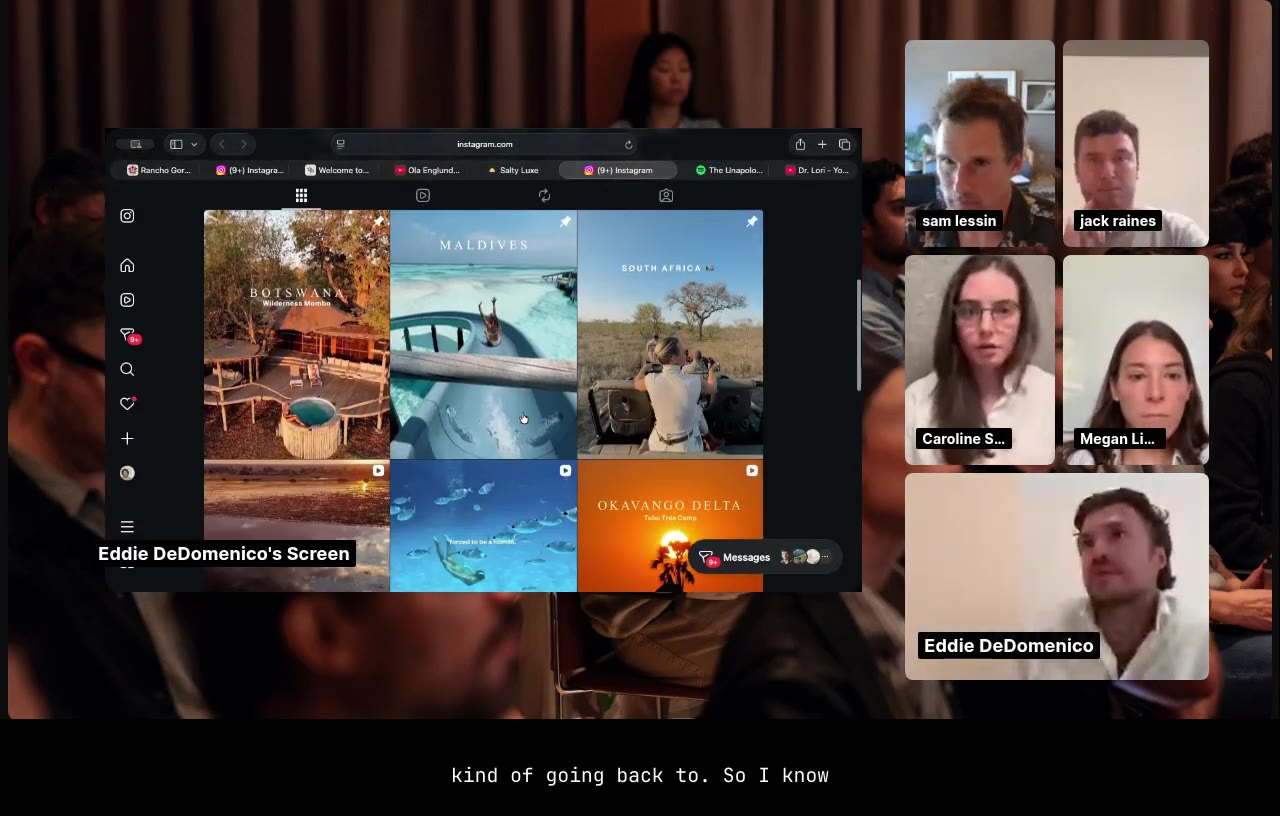
Australian travel creator (Instagram-first, ~400K followers) whose curated small-group trips (under ten people; Africa, the Great Barrier Reef and other exotic destinations; boutique stays rather than the Four Seasons or the same overwater bungalows everyone books) sell out -- Caroline says the 2027 departures are close to waitlisted or sold out. The core clientele is women traveling solo who want to live the life Sarah shows and end up making friends on the trip. Caroline brought it as a category thesis (ultra-luxury experiences people can emulate, with a strong community undertone, in the vein of Eric Lang and Great Estates) more than a hard pitch, and acknowledged the higher bar for a non-US creator. Reaction was lukewarm: Megan and Sam see travel as very crowded unless it's denominated in something more specific; Sam said it's worth a conversation to learn. Eddie's key test, from the Eric Lang reference calls: are guests there for her, or for a dialed operation?
4:55
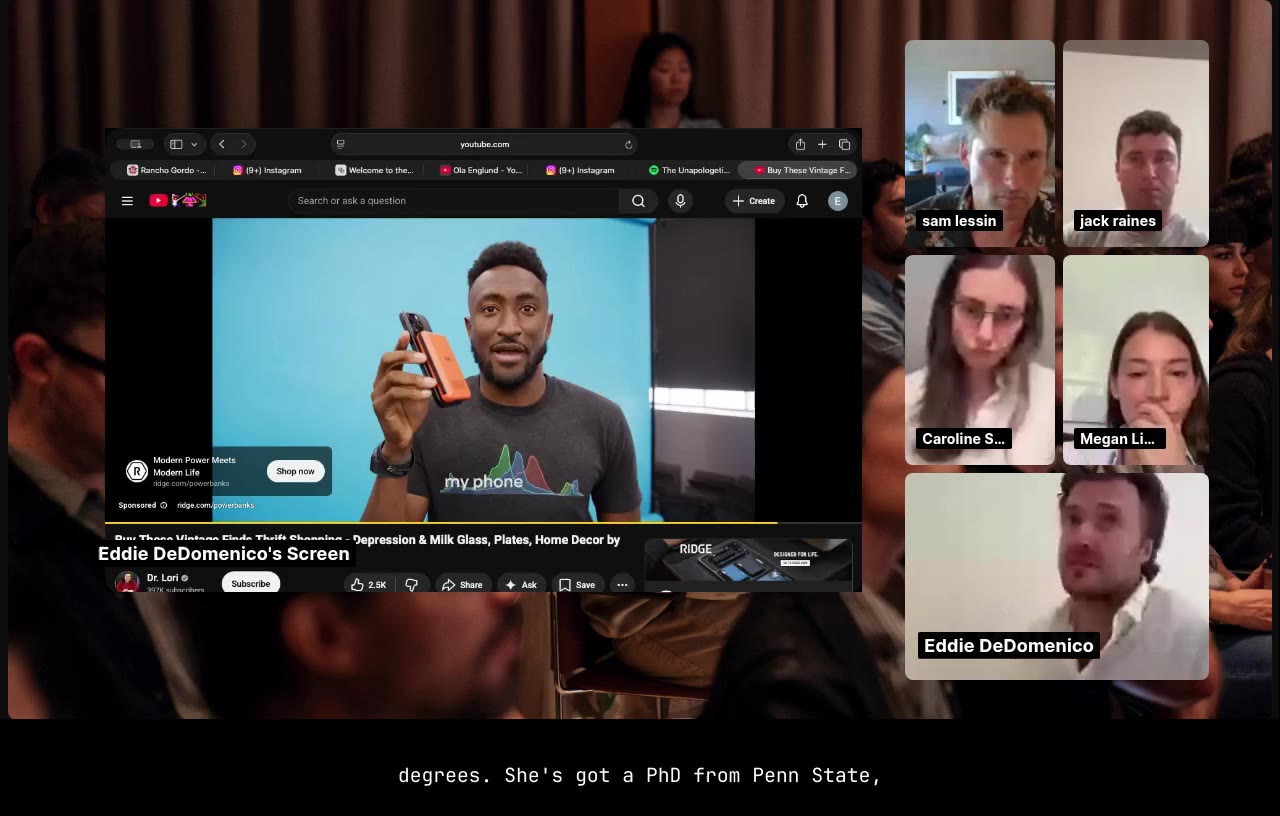
Highly credentialed art historian (four degrees, PhD from Penn State, Yale, decades in prestigious museums) whose brand is nominally antiques appraisal but really functions as thrifting, reselling and estate downsizing. Her community, 'Dr. Lori Nation', watches with transactional intent -- they're deciding what to buy and where, and her word is gospel. She does 150-200 live comedy appraisal events a year (since 1998), writes a column syndicated to ~400 publications (~9M readers claimed), vets objects for major unscripted shows on Netflix and Amazon, and is booked on local-TV segments across the country through the year, sometimes several markets a day. Eddie's scale idea: franchise the trust into a national estate liquidation network, with institutional appraisal for insurers as the high-margin attachment. Eddie wants to talk to her. Megan's pushback: after 25+ years, why hasn't she already done this? Eddie and Jack: Colonel Sanders built KFC at 64; Slow backed Martha Stewart at 85.
4:30
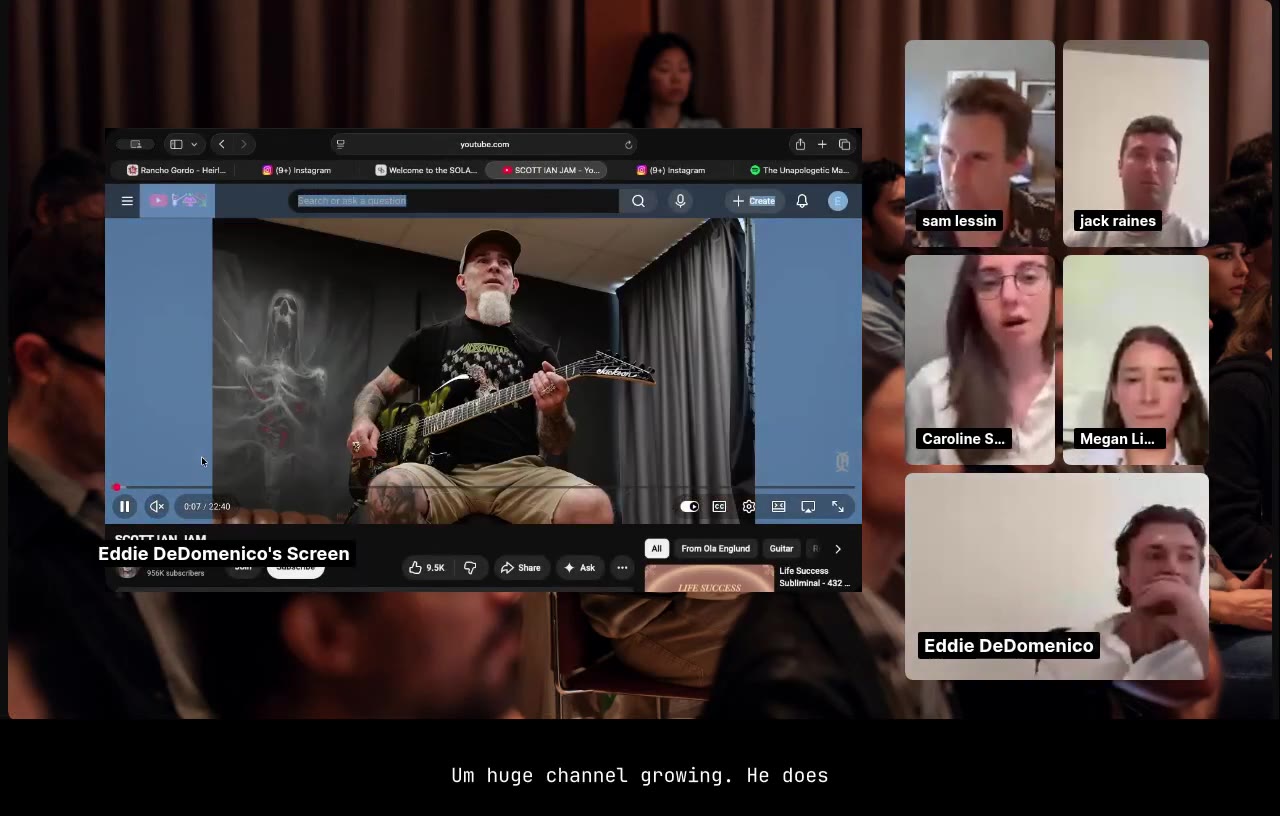
Swedish guitarist (The Haunted, Feared) who is the creator for metal and rock guitarists: a huge, still-growing YouTube channel of gear reviews, demos and artist interviews. He founded Solar Guitars in 2017 as a direct-to-consumer instrument brand (guitars, basses, pedals, accessories) after the channel was already big, which Caroline reads as a sign he understood the audience before productizing. Niche but high-spend community, global draw (heavy European influence, international shipping) and less crowded than the traditional/custom guitar space. Sam asked for the single frame on why fans love it; Caroline: they love him -- he's an insider who brings on credible names, including a fast-rising French rock band that rarely does interviews. Megan and Eddie both want the conversation; Eddie wants to be on the call. (Caroline thought he was likely US-based; he is Stockholm-based.)
5:52
Self-described NLP dating coach for men; Eddie brought him as the answer to earlier pushback on the 'pickup artist' category -- this is the guy making millions doing it. Claims 5,000 men coached at a 95% success rate, charging $5-10K for a 12-week program of twice-weekly Zoom sessions split between Mark and three associates. Main platform is his podcast (The Unapologetic Man Podcast, 6M+ downloads) with an okay Instagram (~125K) and an undeveloped YouTube; the audience is affluent, peak-performance men 30-45 who keep coming back. Eddie's path to scale: reframe from seduction to social confidence and anxiety work, then productize the conversation practice into software (an 'interstitial space' between sessions, like Amali/Moods for therapy). Jack: obviously printing money and a timeless, AI-proof business (cf. Mark Manson's conferences, Blaine Anderson's $25K-a-date matchmaking), but the hard part is making it investable without it feeling like pickup artistry. Sam: high-end matchmaking is clearly a good business; the question is whether it can be a great one, since outside Match-style platforms there are few huge examples (cites his own yenta.com with Slow founder Mike Galpert, hierarchy of needs, K-shaped economy). Eddie says there's a way into him, he's business-minded and not toxic.